IHA Cloud

Author name: Naresh Kumar

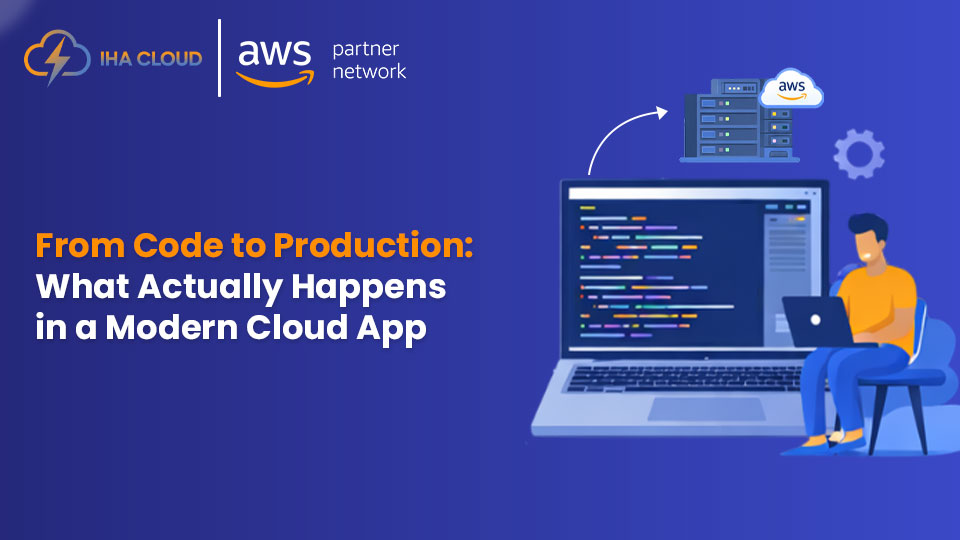
From Code to Production: What Actually Happens in a Modern Cloud App 

For many business leaders and non-technical stakeholders, a cloud application can feel like a black box. Code is written by developers, and somehow it becomes a live application used by customers. What happens in between is often unclear, yet those steps directly affect speed, reliability, security, and cost.  This article explains, in simple and practical terms, how a modern cloud application moves from code to production—and why each step matters to your business.  Step 1: Writing the Code  Everything starts with code. Developers write application logic, user interfaces, and APIs using programming languages and frameworks suited to the product.  At this stage:  Good code alone is not enough. What matters is how safely and efficiently it moves to production.  Step 2: Version Control and Collaboration  Once code is written, it is stored in a version control system such as Git. This allows teams to:  Version control is critical for accountability and stability, especially as teams grow.  Step 3: Automated Build and Testing  When code is updated, automated systems take over. This process is commonly called CI (Continuous Integration).  Here, the system:  This step ensures that broken or risky code never reaches customers.  Step 4: Packaging the Application  Modern cloud applications are usually packaged in a consistent format, often using containers.  This ensures:  Packaging removes the “it works on my machine” problem.  Step 5: Deployment to Cloud Environments  After testing and packaging, the application is deployed to cloud environments such as development, staging, or production.  This process is automated using CI/CD pipelines, which:  In cloud environments, applications can be deployed without downtime, even while users are active.  Step 6: Infrastructure and Scaling  Behind the scenes, cloud infrastructure supports the application.  This includes:  The cloud allows applications to:  Step 7: Security, Monitoring, and Reliability  Once the application is live, continuous monitoring begins.  This includes:  Problems are detected early, often before customers notice them. This is essential for maintaining trust and uptime.  Step 8: Continuous Improvement  A modern cloud app is never “finished.”  Teams continuously:  Cloud platforms make this ongoing improvement possible without disrupting users.  Why This Process Matters for Businesses  This end-to-end flow is not just a technical process. It directly impacts:  When these steps are poorly designed or manually handled, businesses face downtime, slow releases, and higher costs.  How IHA Cloud Supports the Full Journey  At IHA Cloud, we help businesses manage the entire journey from code to production—reliably and efficiently.  We help you:  Whether you are launching a new product or modernizing an existing application, we ensure your cloud setup supports business growth, not operational risk.  Final Thoughts  From code to production, a modern cloud application goes through many critical steps. When designed correctly, this process enables faster innovation, higher reliability, and better cost control.  Understanding this flow helps business leaders make better decisions and choose the right cloud strategy and partners.

From Code to Production: What Actually Happens in a Modern Cloud App  Read More »

When the Internet Blinked: Inside the November 18 Cloudflare Outage and What Really Happened  

On November 18, 2025, the Internet hit a strange and unexpected speed bump. Websites worldwide — from small businesses to major enterprises — began showing error pages. Apps struggled to connect. Authentication systems failed. Even Cloudflare’s own status page briefly went offline. At first glance, it looked like the start of a massive cyberattack. But the truth was far more surprising. In this detailed breakdown, we at IHA Cloud walk through exactly what happened, why it happened, and what the incident tells us about the hidden complexity of the Internet’s infrastructure. A Normal Day — Until 11:20 UTC   Cloudflare operates one of the most widely distributed networks in the world. At 11:20 UTC, that network suddenly began returning 5xx errors — essentially an internal server failure — for millions of requests. Visitors saw Cloudflare-branded error messages when trying to access sites. Behind the scenes, engineers saw erratic behavior: traffic would fail, then suddenly recover, then fail again. This “flickering” made the situation look eerily like a high-volume, targeted DDoS attack. But the real cause was much quieter — and buried deep inside Cloudflare’s internal systems. Not an Attack — A Database Permission Change Gone Wrong   The outage began with an update to Cloudflare’s ClickHouse database cluster. The update was meant to improve permission management and make queries more secure. But one unexpected side-effect changed everything. How it spiraled:   To make things worse, the feature file was regenerated every 5 minutes. Sometimes it was generated correctly. Sometimes it wasn’t. That’s why Cloudflare experienced a cycle of: ✔ normal service✖ failure✔ normal service✖ failureThis back-and-forth made diagnosis extremely difficult. Why Engineers First Suspected a DDoS Attack   During this chaos, another unrelated glitch occurred:Cloudflare’s status page — which is hosted outside Cloudflare — went down due to an entirely separate issue. To engineers dealing with fluctuating errors, massive 5xx spikes, and a dead status page… it looked exactly like a coordinated large-scale attack. Even internal chats reflected this suspicion. Only later did the team trace the root cause: the oversized Bot Management feature file. How Cloudflare Stabilized the Internet Again   It took several steps to untangle the issue: 1. Stopping the spread of the faulty configuration file   Cloudflare paused generation of the feature file to prevent new bad versions from propagating. 2. Rolling back to a last-known-good version   A clean feature file was manually injected into the distribution system. 3. Restarting core proxy services globally   Once devices had the correct file, the routing layer (FL and FL2) began recovering. 4. Fixing downstream services such as:   5. Full recovery:   By 14:30 UTC, most traffic was back to normal.By 17:06 UTC, all Cloudflare systems were fully recovered. Who Was Impacted?   Because Cloudflare sits in front of a huge portion of the Internet, the outage affected: Some users even saw false-positive bot detections because bot scoring failed. Why the Issue Became So Big   This outage wasn’t caused by a single bug — it was a combination of: ✔ A database permissions change   Exposing additional metadata by accident. ✔ A configuration file generator depending on that metadata   Which doubled its output size. ✔ A strict size limit in the bot module   Causing a panic when exceeded. ✔ Global propagation of changes   Which meant the incorrect file hit machines everywhere, almost instantly. ✔ A coincidence: the Cloudflare status page failing simultaneously   Creating confusion during early investigation. This rare “perfect storm” turned a simple metadata change into a multi-hour global outage. How Cloudflare Plans to Prevent This in the Future   Cloudflare has publicly committed to several improvements: 1. Harden validation of internal config files   Even internally generated files will be treated like user input — validated before they roll out. 2. Global kill switches   Allowing teams to instantly disable problematic features. 3. Improved error handling   Eliminating unbounded memory allocations and avoiding system panics when limits are exceeded. 4. Better safeguards between systems   So database metadata changes can’t silently propagate into runtime systems without checks. 5. Updated failure mode reviews  Across all core proxy modules (FL & FL2). Why This Outage Matters (Even If Your Site Wasn’t Down)   Incidents like this remind us how interconnected the Internet is. A change inside a globally distributed cloud platform — even a small one — can ripple into major outages. But they also highlight how much engineering effort goes into ensuring reliability every day. At IHA Cloud, we study incidents like this not to point fingers, but to improve our own infrastructure practices and resilience models. Understanding these failures helps the entire industry evolve. Final Thoughts   Cloudflare hasn’t had an outage of this scale since 2019. This one was painful, unexpected, and complex — and Cloudflare has openly acknowledged it. The silver lining? The Internet recovered quickly, lessons were learned, and the global cloud ecosystem becomes stronger each time we analyze such events. If you want a simpler summary: 👉 A database change caused a config file to double in size →A size limit caused the routing software to crash →The crash caused 5xx errors worldwide →Cloudflare fixed it by rolling back the file and stabilizing the network.We hope this breakdown gives you a clear and understandable look at what happened on November 18, 2025 — one of the Internet’s most unusual days in recent memory.

When the Internet Blinked: Inside the November 18 Cloudflare Outage and What Really Happened   Read More »

Scroll to Top