E-commerce businesses are collecting more customer and product data than ever, but managing that data and turning it into useful customer experiences can be challenging.
This is where AI can make a practical difference.
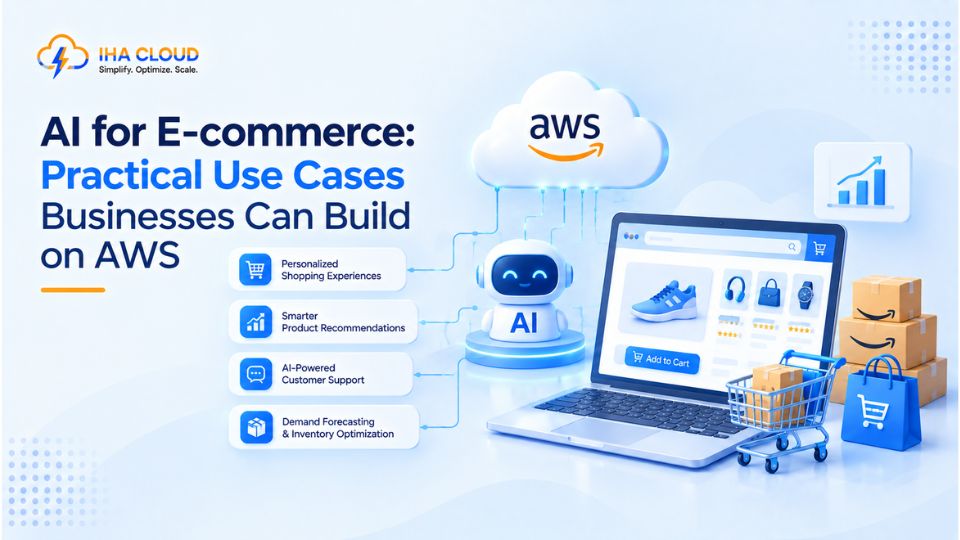
With AWS cloud infrastructure and generative AI technologies, e-commerce businesses can build AI-powered solutions that improve product discovery, automate customer support, and help teams understand customer behavior.
Here are some practical AI use cases e-commerce businesses can explore on AWS.
1. AI Shopping Assistants
Online shoppers often know what they want but may not know exactly which product to choose.
An AI shopping assistant can understand natural-language questions and help customers discover relevant products.
For example, a customer could ask:
“I need running shoes under ₹5,000 for daily use.”
Instead of relying only on traditional filters, an AI assistant can understand the customer’s requirements and provide relevant product suggestions.
Businesses can use Amazon Bedrock with their product catalog and application data to build conversational shopping experiences.
2. Automated Customer Support
Customer support is one of the most repetitive areas of e-commerce.
Customers frequently ask about:
- Order status
- Delivery timelines
- Returns and refunds
- Product information
- Payment issues
- Shipping policies
An AI assistant can handle many routine questions automatically and provide responses based on the company’s own information.
More complex issues can still be transferred to a human support agent.
This approach can help businesses provide support outside traditional working hours while reducing the workload on support teams.
3. Intelligent Product Search
Traditional keyword-based search can sometimes fail when customers don’t use the exact product terms available in a catalog.
AI-powered search can understand the meaning and intent behind a customer’s query.
For example:
“Show me a lightweight laptop for office work under ₹60,000.”
Instead of matching only individual keywords, an AI-powered search experience can understand factors such as product type, use case, price range, and customer requirements.
AWS services such as Amazon OpenSearch Service can be combined with AI capabilities to create more intelligent search experiences.
4. AI-Powered Product Recommendations
Product recommendations can help customers discover products that match their interests and shopping behavior.
AI can analyze available data such as:
- Previous purchases
- Product views
- Search behavior
- Product categories
- Customer preferences
Businesses can then use these insights to provide more relevant recommendations throughout the customer journey.
The goal isn’t simply to show more products. It’s to make product discovery more relevant to each customer.
5. Customer Insights with AI
E-commerce businesses generate large amounts of customer and operational data.
AI can help teams turn this information into useful insights.
For example, businesses could use AI to identify:
- Frequently asked customer questions
- Common product issues
- Changing customer preferences
- Support trends
- Reasons behind abandoned journeys
Generative AI can also help teams interact with business information using natural-language questions instead of manually going through large datasets.
Building These AI Solutions on AWS
AWS provides the infrastructure and services needed to build, integrate, deploy, and scale AI applications.
Depending on the use case, an e-commerce solution could combine services such as:
- Amazon Bedrock for generative AI applications
- Amazon OpenSearch Service for intelligent search and retrieval
- Amazon S3 for storing product and business data
- AWS Lambda for application logic and automation
- Amazon API Gateway for connecting AI capabilities with applications
- Amazon DynamoDB for scalable application data
The exact architecture depends on the business requirements, existing applications, data sources, and security needs.
Start With One Practical Use Case
E-commerce businesses don’t need to implement AI everywhere at once.
A better starting point is to identify one repetitive or high-impact customer problem and build a focused AI solution around it.
For one business, that could be an AI shopping assistant. For another, it could be customer support automation or intelligent product search.
Once the solution proves useful, it can be expanded into other parts of the customer journey.
Conclusion
AI is becoming a practical technology for e-commerce, not just a future concept.
From conversational shopping assistants and intelligent search to automated support and customer insights, businesses can use AI on AWS to build smarter digital experiences while working with their existing cloud infrastructure and data.
IHA Cloud helps businesses design, deploy, and manage cloud and AI solutions on AWS — from architecture and integration to optimization and ongoing management.