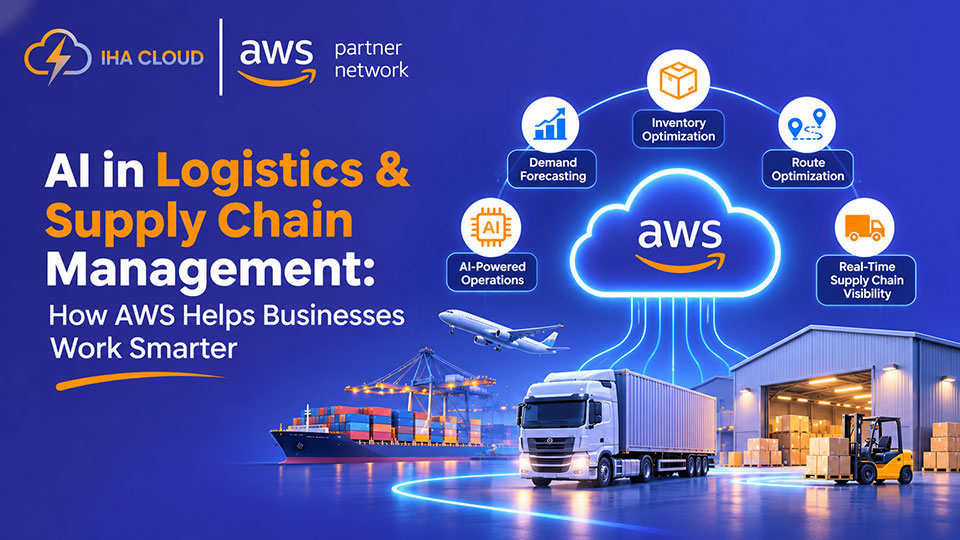
Logistics and supply chain businesses manage complex operations every day, from inventory planning and warehouse management to transportation and last-mile delivery. As customer expectations increase and delivery timelines become shorter, businesses need smarter ways to manage these operations.
Artificial Intelligence (AI) is helping transform the logistics industry by improving demand forecasting, optimizing delivery routes, automating warehouse processes, and providing better insights into business operations.
With Amazon Web Services (AWS), businesses can build scalable AI-powered solutions that help streamline workflows, improve operational visibility, and make data-driven decisions.
In this blog, we’ll explore how AI is transforming logistics and supply chain management and how IHA Cloud helps businesses build and optimize their AWS environments.
1. Improve Demand Forecasting with AI
Accurately predicting customer demand is one of the biggest challenges in supply chain management. Overstocking increases storage costs, while insufficient inventory can lead to missed sales and delivery delays.
AI can analyze historical sales, seasonal trends, customer demand, and other relevant data to help businesses forecast future requirements.
With AWS machine learning and analytics services, logistics companies can develop forecasting solutions that help them:
- Predict future product demand.
- Identify seasonal purchasing patterns.
- Plan inventory more effectively.
- Reduce unnecessary stock levels.
Better forecasting helps businesses make more informed inventory and purchasing decisions.
2. Optimize Delivery Routes and Transportation
Transportation costs and delivery delays can affect the overall efficiency of logistics operations.
AI-powered route planning solutions can analyze traffic conditions, delivery locations, distance, and other factors to help businesses identify efficient delivery routes.
Using AWS cloud infrastructure, businesses can develop applications that support:
- Smarter delivery route planning.
- Better fleet utilization.
- Delivery schedule management.
- Real-time operational visibility.
These capabilities can help logistics companies improve transportation planning and create more reliable delivery experiences.
3. Automate Warehouse and Inventory Management
Managing large warehouses involves repetitive tasks, inventory tracking, product classification, and stock monitoring.
AI can support warehouse operations by helping businesses identify inventory patterns, process operational data, and automate selected workflows.
For example, computer vision solutions can help identify products, inspect packages, and support quality checks.
AWS services such as Amazon Rekognition and AWS IoT services can support different computer vision and connected-device use cases, depending on the application requirements.
Businesses can use these technologies to improve inventory visibility and make warehouse operations more efficient.
4. Improve Supply Chain Visibility with Data Analytics
Supply chains involve multiple stakeholders, suppliers, warehouses, transportation partners, and customers. Managing information across these different systems can be challenging.
AI and cloud-based analytics can help businesses bring operational data together and identify patterns that may otherwise be difficult to detect.
For example, businesses can analyze:
- Inventory movement across warehouses.
- Supplier performance and delivery trends.
- Transportation and shipping data.
- Order processing and fulfillment performance.
AWS analytics services can help businesses process large volumes of operational data and turn it into useful insights for planning and decision-making.
5. Enhance Customer Support with AI
Customers expect quick updates about their orders, delivery schedules, and shipment status. Handling every inquiry manually can put pressure on customer support teams.
AI-powered assistants can help logistics businesses automate routine customer interactions.
Using Amazon Bedrock, businesses can build generative AI assistants that can:
- Respond to common delivery-related questions.
- Provide shipment information when connected to authorized tracking systems.
- Help customers understand delivery procedures.
- Support customer service teams with information retrieval.
This can improve response times and help businesses manage customer communication more efficiently.
6. Why AWS Is a Strong Foundation for AI in Logistics
AI solutions need reliable infrastructure to process data, connect applications, and support growing business requirements.
AWS offers a range of cloud, AI, machine learning, and analytics services that businesses can use to develop logistics solutions.
Some relevant AWS services include:
- Amazon Bedrock: Build generative AI applications and intelligent assistants.
- Amazon SageMaker: Develop, train, and deploy machine learning models.
- Amazon Redshift: Analyze large volumes of business and operational data.
- AWS IoT: Connect devices and collect operational data from connected systems.
- Amazon Rekognition: Support image and video analysis use cases, including selected warehouse inspection applications.
The right combination of AWS services depends on the business’s operational requirements, data availability, and AI objectives.
How IHA Cloud Helps Logistics Businesses Adopt AI on AWS
Adopting AI requires more than choosing the right technology. Businesses also need a secure, scalable, and cost-efficient cloud environment to support their applications and workloads.
IHA Cloud helps businesses build, deploy, manage, and optimize AWS infrastructure based on their technical and operational requirements.
Our AWS expertise can help logistics and supply chain businesses with:
- AWS Infrastructure Setup: Build cloud environments for logistics applications and business systems.
- AI Workload Integration: Support the integration of AWS AI and machine learning services into existing applications.
- Cloud Security: Implement security practices to protect business applications and data.
- Scalability: Design infrastructure that can support increasing workloads and business growth.
- Cost Optimization: Identify opportunities to improve AWS resource utilization and manage cloud spending.
Whether you manage a logistics company, warehouse operation, transportation network, or supply chain platform, IHA Cloud can help you explore the right AWS foundation for your AI initiatives.
Conclusion
AI is creating new opportunities for logistics and supply chain businesses to improve demand forecasting, optimize transportation, streamline warehouse operations, and deliver better customer experiences.
AWS provides the cloud infrastructure and AI services needed to build these capabilities, while the right implementation strategy helps businesses use them effectively.
With IHA Cloud, businesses can take practical steps toward adopting AI on AWS while building secure, scalable, and optimized cloud environments.