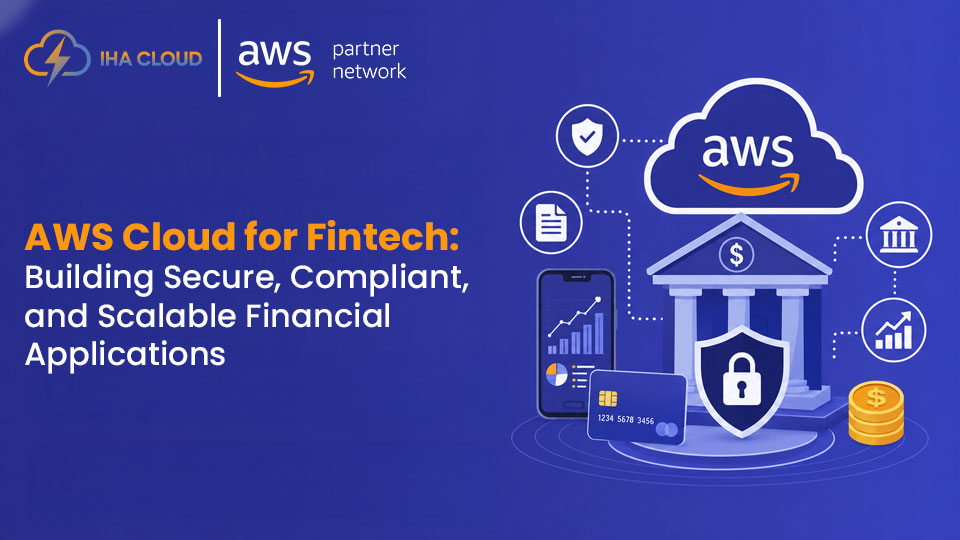
AWS Cloud for Fintech: Building Secure, Compliant, and Scalable Financial Applications
Fintech is one of the most demanding cloud environments that exists. Payment processing, lending platforms, investment apps, and digital banking products must be simultaneously fast, always available, absolutely secure, and fully compliant with financial regulations. A single security breach or compliance failure can end a fintech company. AWS is the cloud platform of choice for global fintech companies precisely because it combines enterprise-grade security, compliance certifications, and the breadth of services needed to build sophisticated financial applications. IHA Cloud brings deep AWS expertise to fintech teams across India and the USA. Regulatory Compliance on AWS for Fintech PCI DSS (Payment Card Industry Data Security Standard): AWS maintains PCI DSS Level 1 certification — the highest level. This means AWS’s infrastructure meets the strictest requirements for storing, processing, and transmitting cardholder data. You still need to design your application layer to be PCI-compliant, but AWS handles the underlying infrastructure compliance. RBI Guidelines (India): The Reserve Bank of India mandates that certain financial data must be stored within India. AWS’s Mumbai region (ap-south-1) supports RBI data localisation requirements. IHA Cloud helps Indian fintech companies architect RBI-compliant AWS environments. SOC 2 Type II: AWS holds SOC 2 Type II certification across its core services. This is increasingly required by enterprise customers and investors as proof of security controls. Core AWS Architecture for Fintech Transaction Processing Amazon SQS + Lambda — Decouple payment initiation from processing with guaranteed message delivery and retry logic Amazon RDS (Aurora) — ACID-compliant relational database for transaction records with Multi-AZ failover AWS Step Functions — Orchestrate multi-step financial workflows (loan origination, KYC, payment reconciliation) reliably Fraud Detection Amazon Fraud Detector — ML-powered real-time fraud detection trained on your transaction patterns Amazon Kinesis — Process and analyse transaction streams in real time for anomaly detection Security Controls AWS KMS with customer-managed keys — Full control over encryption of financial data AWS Secrets Manager — Rotate database credentials and API keys automatically without downtime Amazon Macie — Automatically discover and protect sensitive financial data in S3 AWS Network Firewall — Deep packet inspection and threat prevention for fintech VPCs Audit and Compliance AWS CloudTrail — Immutable audit log of every API call — essential for financial audits AWS Config — Continuous compliance monitoring with fintech-specific rules Amazon Security Lake — Centralise security logs for SIEM integration and long-term compliance storage High Availability for Payment Systems Payment systems must target 99.99% uptime. On AWS this means: Multi-AZ RDS with automatic failover under 60 seconds ALB with health checks routing around failed instances instantly Cross-region read replicas for read-heavy reporting workloads AWS Global Accelerator for low-latency global access to payment APIs IHA Cloud Fintech Expertise IHA Cloud works with payment platforms, lending apps, and digital banking products to design AWS environments that pass security audits, meet regulatory requirements, and scale with transaction volume growth. Build your fintech platform on a foundation that regulators and customers trust. Talk to IHA Cloud’s Fintech Team
AWS Cloud for Fintech: Building Secure, Compliant, and Scalable Financial Applications Read More »