AI has moved well beyond the experimentation stage.
In 2026, businesses are no longer asking whether they should explore AI. They are asking a much more practical question:
“How do we take our AI idea from a proof of concept to something that can actually run in production?”
That transition is where many AI projects become difficult.
A prototype may work perfectly with a handful of users and a limited dataset. But once the application needs to handle real traffic, sensitive data, unpredictable workloads, integrations, security requirements, and growing infrastructure costs, the underlying cloud architecture becomes critical.
This is where AWS can provide the foundation businesses need — and where the right cloud strategy can make the difference between an AI project that struggles to scale and one that is ready for production.
At IHA Cloud, we help businesses design, build, optimize, secure, and manage AWS environments that are ready for modern AI workloads.
The Real Challenge Isn’t Building an AI Demo
Getting an AI application to work has become easier.
Getting it to work reliably at scale is a different challenge.
A development team can build an AI-powered application, connect it to a model, and demonstrate the concept in a relatively short time. But production introduces questions that a prototype doesn’t always answer:
- What happens when traffic increases 10x?
- How do you protect customer and business data?
- How do you monitor AI workloads in production?
- How do you keep infrastructure costs under control?
- How do you handle downtime or unexpected failures?
- How do you integrate AI with existing applications and databases?
- How do you deploy new versions without disrupting users?
- How do you make the architecture flexible enough for future AI models?
These aren’t just AI questions.
They’re infrastructure questions.
And the infrastructure underneath an AI application can directly affect its performance, security, reliability, and cost.
Why AWS Infrastructure Matters for AI in 2026
Modern AI applications can have very different infrastructure requirements depending on what they’re doing.
A simple AI-powered feature embedded into an existing SaaS product may have relatively modest requirements.
A real-time AI application, enterprise knowledge assistant, document-processing platform, recommendation engine, or AI-powered analytics system can require significantly more computing resources, storage, networking, databases, monitoring, and security.
AWS provides a broad ecosystem of services that businesses can use to build these environments.
Depending on the architecture, this can include services such as compute, containers, serverless infrastructure, databases, object storage, networking, security, monitoring, and managed AI capabilities.
But having access to hundreds of AWS services doesn’t automatically create a good architecture.
The challenge is choosing the right services and putting them together in the right way.
That’s where cloud expertise becomes important.
From Proof of Concept to Production
The journey from an AI idea to a production application typically looks something like this:
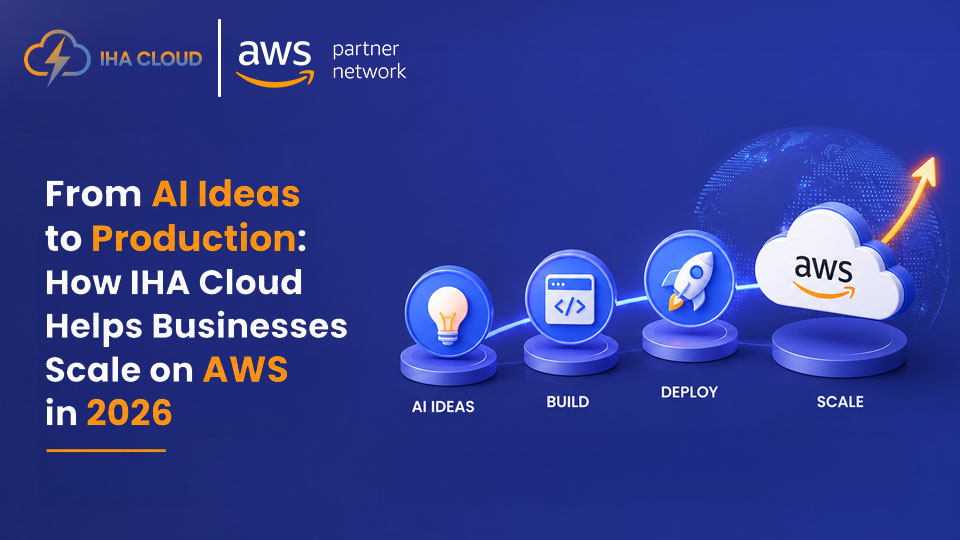
Idea → Prototype → Cloud Architecture → Security → Optimization → Deployment → Monitoring → Scale
Each stage introduces different challenges.
A prototype is primarily about proving that the idea works.
Production is about making sure it continues to work when real customers depend on it.
At IHA Cloud, our role is to help businesses bridge that gap.
1. Designing an AI-Ready AWS Architecture
The first step is getting the architecture right.
Instead of simply moving an existing application to AWS, businesses should think about how the infrastructure needs to support their future requirements.
An AI-ready architecture should consider:
- Application workloads
- Compute requirements
- Data storage
- Database architecture
- Networking
- Security
- Scalability
- Monitoring
- Disaster recovery
- Cost management
For example, an AI application may need to process large amounts of data while simultaneously serving customer requests.
A poorly designed architecture can create bottlenecks as usage grows.
A well-designed architecture can allow individual components to scale based on demand.
The goal isn’t to build the biggest infrastructure possible. It’s to build infrastructure that can grow intelligently.
2. Making AI Applications Scalable
One of the biggest differences between a demo and a production application is traffic.
Your application may work perfectly with 100 users.
But what happens when you have 10,000?
Or 100,000?
This is where scalable AWS architecture becomes important.
Depending on the application, businesses may use technologies such as load balancing, auto scaling, containers, serverless services, caching, managed databases, and distributed architectures.
The objective is simple:
Your infrastructure should scale with your business instead of becoming a limitation to it.
IHA Cloud helps businesses evaluate their workloads and design AWS environments that can accommodate changing demand without unnecessarily overprovisioning infrastructure.
3. Keeping AI Infrastructure Costs Under Control
AI can create significant infrastructure costs when workloads aren’t properly optimized.
The problem isn’t necessarily that AWS is expensive.
The problem is that businesses often pay for resources they don’t actually need or fail to optimize how those resources are being used.
Common issues can include:
- Overprovisioned compute resources
- Idle infrastructure
- Inefficient storage
- Poorly designed databases
- Unoptimized workloads
- Lack of resource monitoring
- Unexpected increases in usage
As AI workloads grow, these inefficiencies can become expensive.
That’s why FinOps and cloud cost optimization should be considered from the beginning, rather than after the monthly AWS bill becomes a problem.
IHA Cloud helps businesses identify unnecessary cloud spending, optimize infrastructure, and create a more predictable AWS cost structure.
4. Building Security Into the Architecture
AI applications often work with valuable business information.
That can include customer data, internal documents, financial information, application data, or proprietary business knowledge.
Security therefore cannot be something added at the end of the project.
It needs to be part of the architecture.
An AWS environment supporting AI workloads should consider areas such as:
- Identity and access management
- Encryption
- Network security
- Access policies
- Logging and monitoring
- Data protection
- Backup strategies
- Compliance requirements
At IHA Cloud, we help businesses evaluate their AWS environments and implement security practices designed around their application and business requirements.
5. Connecting AI With Existing Business Systems
Most businesses aren’t building AI applications in isolation.
They already have websites, SaaS platforms, CRMs, databases, APIs, internal applications, and customer-facing systems.
The real value of AI often comes from connecting these existing systems with intelligent capabilities.
For example:
CRM + AI → Smarter customer insights
Documents + AI → Faster knowledge discovery
Customer data + AI → Personalized experiences
Business data + AI → Better decision-making
Support platform + AI → More efficient customer service
This means the AWS architecture needs to support not just the AI component, but the entire ecosystem around it.
IHA Cloud helps businesses design cloud environments where AI workloads can integrate with existing applications and infrastructure.
6. Monitoring What Happens After Deployment
Deployment isn’t the finish line.
It’s the beginning of the production phase.
Once an AI application is live, teams need visibility into what is happening across the environment.
They need to understand:
- Is the application healthy?
- Are response times increasing?
- Are resources being overused?
- Are errors occurring?
- Are workloads scaling correctly?
- Are costs increasing unexpectedly?
- Are there security events that require attention?
AWS provides extensive monitoring and observability capabilities, but these need to be configured and interpreted effectively.
IHA Cloud helps businesses establish monitoring and operational practices so that infrastructure problems can be identified before they become major business problems.
7. Preparing Infrastructure for What Comes Next
One of the biggest mistakes businesses can make with AI infrastructure is designing only for today’s requirements.
AI technology is evolving quickly.
Models change.
Workloads change.
User expectations change.
Business requirements change.
Your architecture should therefore have enough flexibility to adapt.
Instead of building infrastructure around one specific short-term experiment, businesses should think about how the environment can support future applications, increasing workloads, additional data sources, and new AI capabilities.
Good cloud architecture gives your business room to evolve.
How IHA Cloud Helps Businesses Move From AI Idea to Production
At IHA Cloud, we don’t look at AI infrastructure as simply a collection of AWS services.
We look at the bigger picture.
What are you trying to build?
Who will use it?
What data will it handle?
How much traffic could it receive?
What security requirements exist?
What will it cost to operate?
How will it scale?
From there, we help businesses build an AWS environment aligned with those requirements.
Our support can span:
AWS Architecture
Designing cloud infrastructure around application and AI workload requirements.
Cloud Migration
Moving existing applications and workloads to AWS with a structured migration strategy.
Cost Optimization
Finding opportunities to reduce unnecessary AWS spending while maintaining performance.
Security
Strengthening AWS environments through better access control, monitoring, configuration, and security practices.
DevOps & Automation
Improving deployment processes and reducing manual infrastructure management.
Monitoring & Management
Helping businesses maintain visibility and reliability after deployment.
Scalability
Preparing infrastructure to handle growing workloads and changing business requirements.
AI Success Requires More Than AI
There’s a tendency to think of AI projects as being primarily about models.
But successful production AI requires much more.
It requires data.
It requires applications.
It requires security.
It requires reliable infrastructure.
It requires monitoring.
And it requires cost control.
AWS can provide the foundation for all of these components, but businesses still need a thoughtful architecture and a practical implementation strategy.
That’s where an experienced cloud partner can help.
The 2026 Opportunity: Build AI With the Right Foundation
The businesses that benefit most from AI won’t necessarily be the ones experimenting with the most models.
They’ll be the ones that can turn AI into reliable, scalable, secure, and economically sustainable products and processes.
That starts with the infrastructure.
Whether you’re building your first AI-powered application, migrating an existing workload to AWS, or trying to optimize an AI environment that’s already in production, the right cloud strategy can help you move faster without creating unnecessary complexity.
Your AI idea deserves infrastructure that’s ready for what’s next.