Imagine your entire AWS infrastructure — VPCs, EC2 instances, RDS databases, security groups, load balancers — defined in version-controlled code files. No more clicking through the console, no more undocumented manual changes, no more “who created this resource?” questions at 2 AM.
That’s exactly what Infrastructure as Code (IaC) delivers. It’s one of the most impactful practices a cloud team can adopt — and at IHA Cloud, we implement it as a foundation for every serious AWS engagement.
What is Infrastructure as Code?
Infrastructure as Code is the practice of managing and provisioning cloud resources through machine-readable configuration files rather than manual processes. Your infrastructure is described in code, stored in Git, reviewed like any other software change, and deployed automatically.
The result: consistent, repeatable, auditable infrastructure that scales with your team.
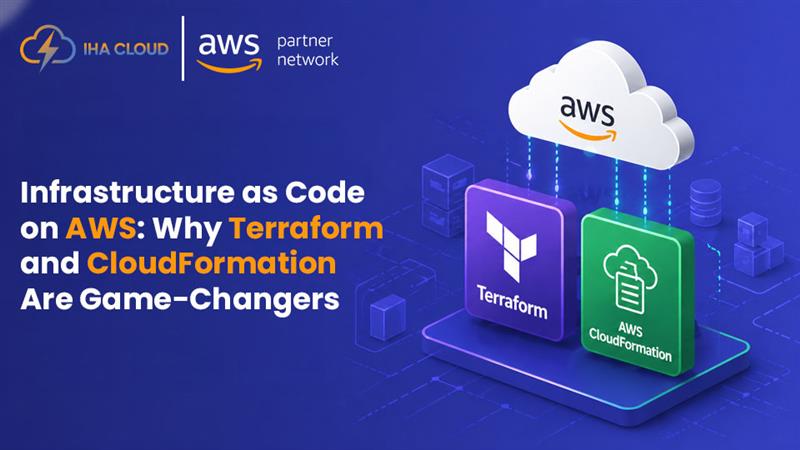
Terraform vs AWS CloudFormation
Two tools dominate IaC on AWS:
Terraform (by HashiCorp):
- Cloud-agnostic — works across AWS, Azure, GCP
- Large community with thousands of reusable modules
- State management via S3 backend with DynamoDB locking
- Human-readable HCL syntax
- Best for: Teams that want flexibility and multi-cloud portability
AWS CloudFormation:
- Native AWS service — deeply integrated with every AWS resource
- No state file management required (AWS handles it)
- Supports AWS CDK for writing infrastructure in Python, TypeScript, Java
- Best for: AWS-only teams wanting tight native integration
At IHA Cloud, we primarily recommend Terraform for its flexibility and ecosystem, with AWS CDK for teams who prefer writing infrastructure in familiar programming languages.
Key Benefits of Adopting IaC
Consistency: Every environment — dev, staging, production — is provisioned identically from the same code. No more “it works in staging but not in prod” surprises caused by configuration drift.
Speed: Spinning up a complete new environment takes minutes instead of hours. New regions, new clients, new projects — all provisioned with a single command.
Auditability: Every infrastructure change is tracked in Git with who made it, when, and why. Compliance audits become straightforward.
Disaster Recovery: If your AWS account is ever compromised or corrupted, you can rebuild your entire infrastructure from code in hours — not days.
Cost Control: IaC enforces tagging policies and resource standards, preventing undocumented or non-compliant resources from being created.
IHA Cloud’s IaC Implementation Approach
Phase 1 – Assessment: We review your current AWS infrastructure and identify all resources that need to be codified.
Phase 2 – Module Design: We design reusable Terraform modules for your most common patterns — VPC, EC2, RDS, ECS, etc.
Phase 3 – State Migration: We import existing AWS resources into Terraform state without downtime.
Phase 4 – Pipeline Integration: IaC changes run through a CI/CD pipeline — plan on pull request, apply on merge to main.
Phase 5 – Governance: We enforce IaC-only changes through AWS SCPs that restrict manual console modifications in production.
Common IaC Mistakes to Avoid
- Storing Terraform state locally instead of in S3 with locking
- Writing monolithic configurations instead of reusable modules
- Not using remote state data sources to share outputs between modules
- Skipping terraform plan reviews in CI — always require peer review
- Hard-coding credentials instead of using IAM roles and environment variables