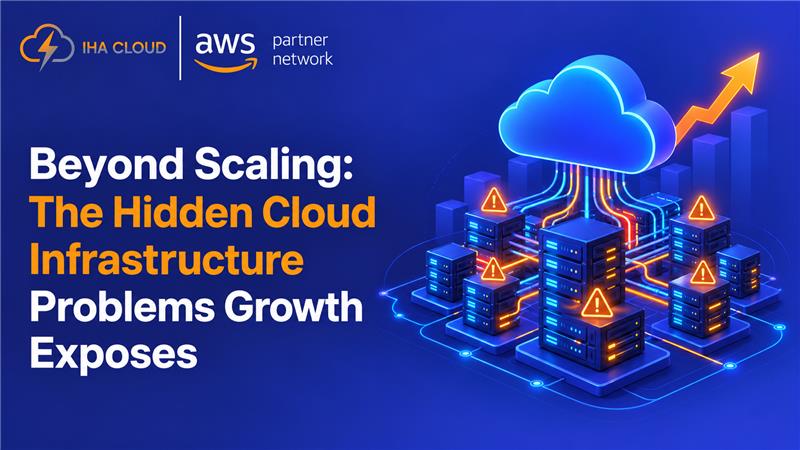
Your cloud infrastructure can handle today’s workload and still be unprepared for tomorrow’s growth.
A SaaS application may run smoothly with predictable traffic and a simple architecture. As the customer base expands, traffic becomes less predictable, integrations multiply, background jobs increase, and more transactions depend on shared services. Nothing may have failed yet, but the assumptions behind the infrastructure begin to show their limits.
That is where cloud infrastructure scalability becomes more than adding servers. A scalable environment must handle changing workloads while maintaining performance, reliability, visibility, cost control, and operational efficiency.
Growth Changes the Shape of the Workload
The biggest change during growth isn’t always the amount of traffic. It is how that traffic behaves.
One customer may trigger a large batch of jobs while others continue using the application. New integrations can increase API traffic, while product launches or seasonal demand can create sudden spikes.
Adding application instances may handle more requests, but it can also increase database connections, queue activity, network traffic, and logging volume. The application may scale successfully at one layer while creating new constraints elsewhere.
The workload doesn’t simply become larger. It becomes more complex.
Your Bottleneck Doesn’t Disappear. It Moves.
Suppose an application is experiencing high CPU utilization. The team adds more application instances, and CPU usage falls.
But those instances may create more database connections. Connection limits are reached, requests begin waiting, and application latency rises again.
The original bottleneck has moved.
This can happen across compute, databases, networking, storage, queues, and external services. Effective cloud infrastructure scalability requires understanding how components depend on one another, not just which resource is currently under pressure.
The question is not only “What is limiting us now?” but also “What becomes the next constraint when we fix it?”
When Application Scaling Increases Database Pressure
Database limitations are common, but the deeper issue is often how the application interacts with the data layer.
An online marketplace might add application capacity to handle more product searches. If every request performs multiple expensive database queries, those additional servers can simply push more work toward the same constrained database.
The solution might involve query optimization, caching, connection management, read scaling, or changes to data-access patterns.
An application can scale horizontally while its architecture remains constrained by how its instances access data.
Scaling Can Also Change the Economics
Infrastructure growth affects more than performance. It changes how efficiently the business uses cloud resources.
Adding capacity can be the right response to genuine demand or an active incident. It becomes problematic when additional resources compensate for inefficient processing, poor resource utilization, or an architectural constraint.
More capacity should solve a workload requirement, not simply mask an architectural problem.
Scalability planning should therefore consider when resources are needed, how long they are needed, and whether additional capacity is actually improving the workload.
More Infrastructure Can Create Less Visibility
As a SaaS platform becomes more distributed, teams have more signals to monitor: latency, database performance, queue depth, API errors, logs, traces, and dependency health.
More data does not automatically provide better visibility.
Consider a workflow that depends on authentication, an internal API, a database lookup, and a third-party service. Overall response time may remain acceptable while that third-party service intermittently slows one critical step.
A broad average may barely move, but customers can still experience delays.
Effective observability therefore needs to connect infrastructure signals to specific customer-facing behavior, helping teams identify which service or dependency is affecting a workflow.
Reliability Becomes a Larger Business Concern
As more customers, features, and integrations depend on the same environment, individual components can become critical dependencies across multiple workflows.
Authentication, payments, messaging, data processing, and external APIs may support several parts of the customer experience. A failure in one component can therefore affect more than the service where it originated.
That makes resilience part of scalability.
Can the system isolate failures? Can non-essential functionality continue? Can traffic be redirected? Can the environment recover without extensive manual intervention?
A scalable architecture must account not only for how much demand it can handle, but also for how it behaves when something goes wrong.
The First Scaling Constraint May Be the Team
Operational complexity can become another scaling limit.
Manual provisioning, configuration changes, deployments, and troubleshooting may work in a small environment. They become harder to maintain as infrastructure expands across services, environments, accounts, regions, and dependencies.
Infrastructure as code, automation, standardized environments, and repeatable deployment processes can reduce manual effort and configuration drift.
Infrastructure scalability and operational scalability need to grow together.
What Should You Examine Before the Next Growth Phase?
Before adding more capacity, examine how the system behaves under changing conditions.
Where does traffic concentrate? Which components depend on shared resources? Which workflows rely on external services? Which resources become expensive during peak demand? Can the team deploy, troubleshoot, and recover changes without heavy manual intervention?
These questions reveal constraints that a simple CPU or memory check may miss.
Build for the Growth You Expect and the Behavior You Don’t
Cloud infrastructure scalability is ultimately about preparing an environment for change.
Traffic patterns will shift, dependencies will increase, workloads will become more distributed, and operational complexity will grow. The architecture that worked at an earlier stage may need to evolve with the business.
Preparing for that transition means identifying constraints early, automating processes that become difficult to manage manually, and continuously evaluating how the environment behaves as workloads change.
Before the next growth milestone arrives, the important question isn’t how much more infrastructure you can add. It is whether your architecture is ready for the way that growth will actually behave.