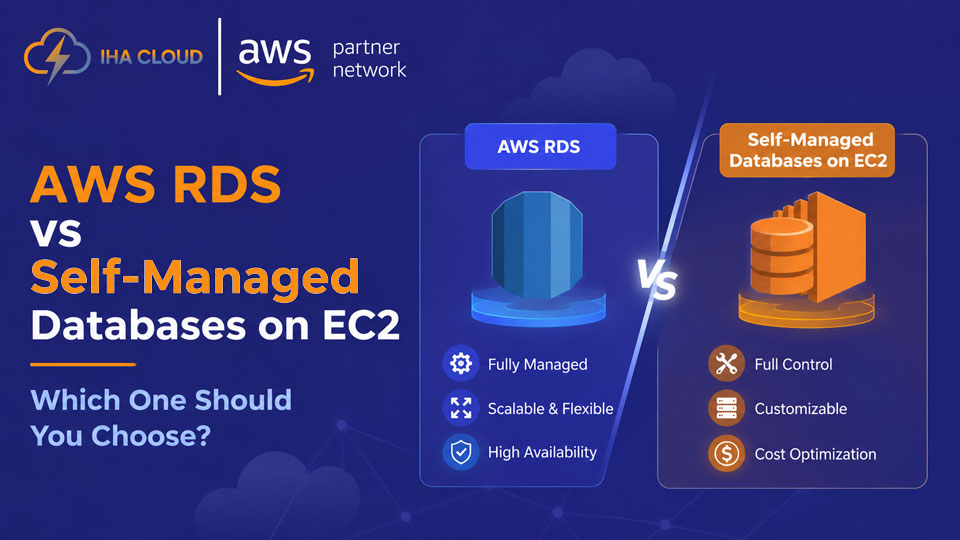
Every team that moves to AWS eventually faces the same question: should we use RDS or just install the database on an EC2 instance ourselves? Both options work. But they solve different problems, carry different costs, and require different levels of effort to maintain.
Here is a straight comparison so you can make the right call for your workload.
What Is the Actual Difference?
With RDS, AWS manages the database engine — provisioning, patching, backups, Multi-AZ failover, and monitoring. You connect to it like any database, but you do not touch the underlying server.
With a self-managed database on EC2, you install the engine yourself (MySQL, PostgreSQL, SQL Server, whatever), configure everything, and own every aspect of operations — including backups, upgrades, replication, and recovery.
When RDS Makes Sense
- You do not have a dedicated DBA on your team
- You need automated backups and point-in-time recovery out of the box
- High availability matters — Multi-AZ with automatic failover is a checkbox in RDS
- You want read replicas without configuring replication yourself
- Compliance requires automated patching and audit logs
RDS costs more per hour than an equivalent EC2 instance. You are paying for the managed layer. For most small and mid-sized businesses, that premium is worth it — it eliminates an entire category of operational risk.
When Self-Managed on EC2 Makes Sense
- You need a database engine or version that RDS does not support
- You need OS-level access for specific tuning or extensions
- You are running a database for development or testing where cost matters more than resilience
- Your team has strong DBA expertise and you want full control
The hidden cost of self-managed is engineer time. Patching, backup verification, replication setup, and failover testing all fall on your team.
Cost Comparison
| Factor | RDS | EC2 Self-Managed |
| Hourly cost | Higher | Lower |
| Backup automation | Built-in | Manual setup required |
| High availability | Multi-AZ, one click | Replication + manual failover |
| Patching | Managed by AWS | Your responsibility |
| Engine flexibility | Limited to RDS engines | Any engine, any version |
| DBA time required | Minimal | Significant |
Our Recommendation
For production workloads in growing businesses, RDS is almost always the right starting point. The operational overhead of self-managing a database at scale is underestimated until something goes wrong at 2 AM.
If you are hitting RDS limitations — specific extensions, exotic configurations, or extreme cost pressure at high scale — then EC2 with a well-architected setup is worth the investment.