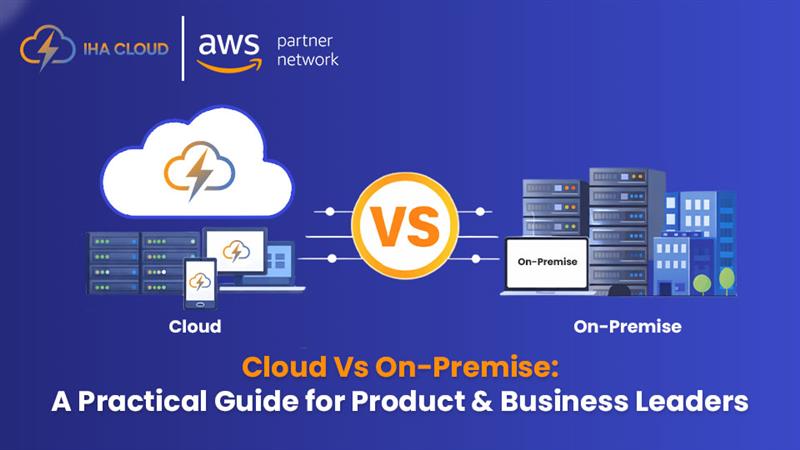
For product owners, founders, CIOs, and business leaders, infrastructure decisions directly impact cost, scalability, security, and long-term growth. One of the most important choices organizations face is whether to adopt cloud infrastructure or continue operating on on-premise systems.
There is no universal answer. The right approach depends on business objectives, operational priorities, regulatory requirements, and future expansion plans. This guide provides a clear, practical comparison to help decision-makers choose the infrastructure model that aligns with their business strategy.
Understanding the Basics
What Is On-Prem Infrastructure?
On-premise (On-Prem) infrastructure refers to servers, storage, and networking equipment that are physically hosted within an organization’s own facility or data center. The organization is fully responsible for managing and maintaining the environment, including:
- · Hardware procurement and lifecycle management
- · System maintenance and upgrades
- · Security controls and compliance
- · Power, cooling, backups, and disaster recovery
This model offers complete control but requires significant investment and ongoing operational effort.
What Is Cloud Infrastructure?
Cloud infrastructure allows organizations to consume computing resources from providers such as AWS, Microsoft Azure, or Google Cloud. Instead of owning physical hardware, businesses pay for resources based on actual usage.
Operational responsibilities such as availability, scalability, and infrastructure resilience are handled by the cloud provider or a managed services partner like IHA Cloud, allowing internal teams to focus on core business activities.
Cloud Vs On-Prem: Real-World Comparison
1. Cost and Investment
On-Prem
- High upfront capital expenditure
- Ongoing hardware refresh and maintenance costs
- Fixed capacity regardless of actual utilization
Cloud
- Consumption-based pricing model
- No upfront hardware investment
- Costs scale according to usage
For startups and growing organizations, cloud significantly reduces financial risk and avoids over-provisioning.
2. Scalability and Growth
On-Prem
- Scaling requires purchasing and deploying new hardware
- Expansion cycles can take weeks or months
Cloud
- Resources can be scaled up or down within minutes
- Well suited for variable workloads and rapid growth
Organizations with unpredictable or seasonal demand benefit from the flexibility cloud offers.
3. Security and Compliance
On-Prem
- Full physical control over data and systems
- Security effectiveness depends on internal expertise and processes
Cloud
- Built-in enterprise-grade security controls
- Support for industry compliance standards such as ISO, SOC, and GDPR
- Shared responsibility model between provider and customer
When properly designed and managed, cloud environments often meet or exceed traditional security standards.
4. Maintenance and Operations
On-Prem
- Requires dedicated in-house IT teams
- Hardware failures can result in extended downtime
- Manual patching, updates, and backups
Cloud
- Automated updates and backup mechanisms
- High availability and disaster recovery options
- Managed services reduce operational complexity
Cloud enables organizations to shift focus from infrastructure management to business growth.
5. Speed and Innovation
On-Prem
- Longer deployment cycles
- Limited access to advanced services
Cloud
- Faster application deployment and releases
- Access to DevOps, automation, analytics, and AI services
Cloud platforms enable faster innovation and improved time-to-market.
Choosing the Right Model
Cloud Is Suitable If:
- You are a startup or scaling organization
- Faster product launches are a priority
- Cost flexibility and optimization are required
- You are adopting DevOps and automation practices
On-Prem May Be Suitable If:
- Regulatory or data residency requirements are strict
- Significant investment has already been made in infrastructure
- Full physical control over systems is mandatory
Many organizations adopt a hybrid approach, combining cloud and on-prem infrastructure to balance control, flexibility, and performance.
A Common Mistake Organizations Make
The most frequent issue is not choosing cloud or on-prem, but making the decision without a defined strategy.
Without proper architecture, security planning, and cost governance, cloud environments can become inefficient and expensive. Strategic planning and experienced guidance are essential for long-term success.
How IHA Cloud Supports Your Infrastructure Strategy
At IHA Cloud, we focus on aligning technology decisions with business outcomes. We do not promote cloud adoption by default. Instead, we evaluate what best fits your organization.
Our services include:
- Infrastructure and cloud readiness assessments
- Cloud, on-prem, and hybrid architecture design
- Secure migration with minimal disruption
- Cost optimization and performance tuning
- Ongoing DevOps and cloud operations support
Whether you are starting your cloud journey, migrating existing workloads, or optimizing current infrastructure, we provide end-to-end guidance and support.
Conclusion
Cloud vs On-Premises is fundamentally a business decision, not just a technical one.
The right infrastructure strategy can:
- Control and reduce operational costs
- Improve reliability and availability
- Enable scalable growth
- Support long-term business objectives
If you are evaluating your infrastructure strategy or planning a transition, a structured discussion can help avoid costly missteps.
Contact IHA Cloud
To discuss your infrastructure requirements or request a consultation