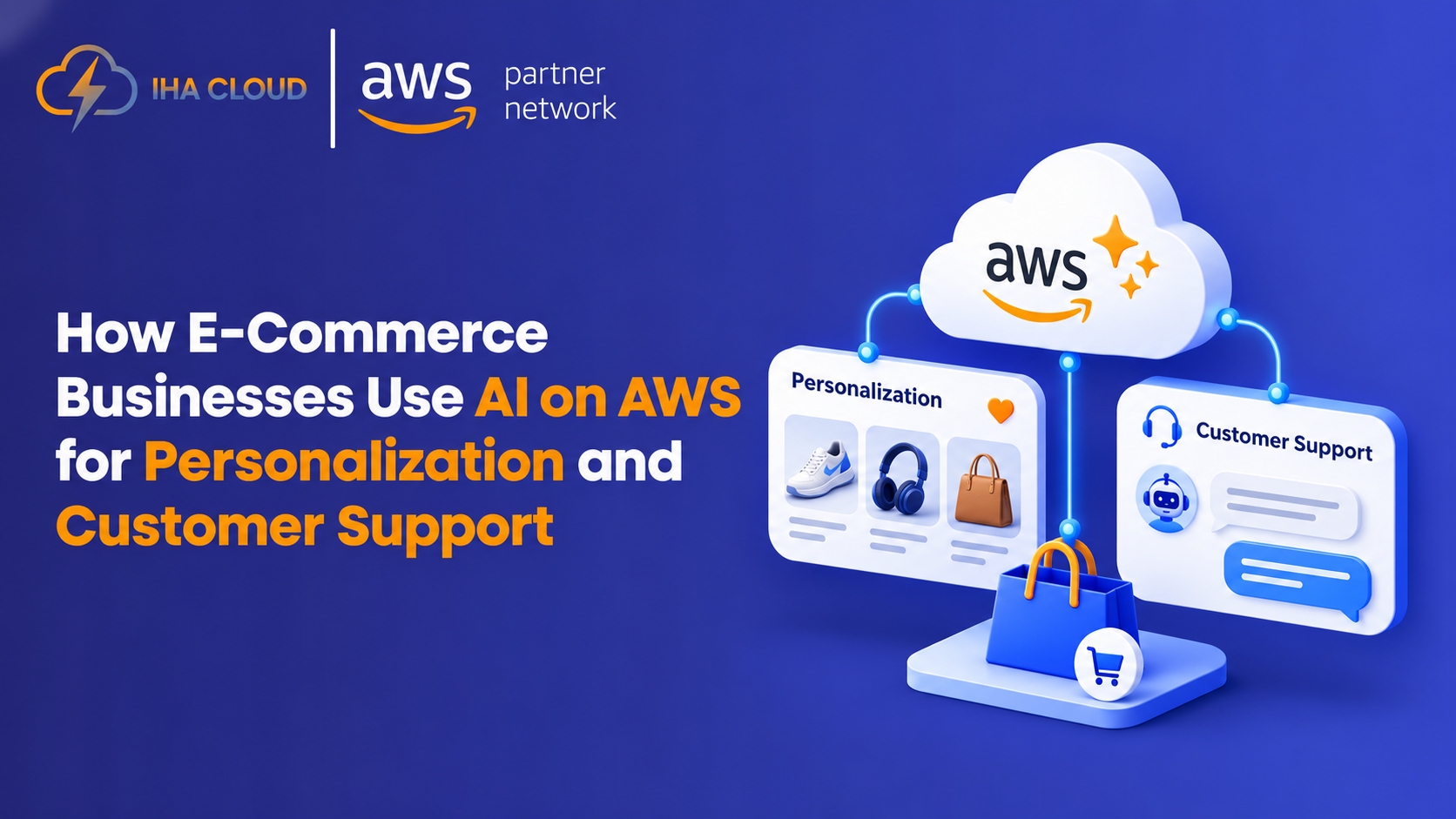
Online shopping has changed the way customers discover products, compare prices, and interact with brands. Today, customers expect more than a website with a large product catalog. They want relevant recommendations, quick answers to their questions, and a smooth shopping experience from product discovery to checkout.
For e-commerce businesses, delivering this experience to thousands of customers can be challenging. Product catalogs grow, customer inquiries increase during sales, and shopping behavior changes constantly.
Artificial intelligence (AI) can help businesses manage these challenges by analyzing customer behavior, personalizing product discovery, and automating parts of customer support.
With Amazon Web Services (AWS), e-commerce businesses can build AI-powered capabilities using cloud infrastructure and managed services without having to develop every component from scratch.
Let’s explore how AI on AWS can improve personalization and customer support for online stores.
1. Personalized Product Recommendations
Every customer has different interests, preferences, and shopping habits. Showing the same products to every visitor may not deliver the best shopping experience.
AI can help e-commerce businesses recommend products based on customer behavior, purchase history, product preferences, and other relevant signals.
For example, if a customer frequently browses fitness equipment, an online store could highlight workout accessories, sportswear, or related products. A customer shopping for a laptop might receive recommendations for compatible accessories.
AWS offers services that can support recommendation systems.
Amazon Personalize allows businesses to build personalized recommendation experiences using their data. It can help generate relevant product recommendations and rank items for different customer experiences.
Businesses can use these capabilities to improve:
- Product recommendations on homepages
- Related product suggestions
- Cross-selling and upselling
- Personalized product discovery
- Product recommendations based on shopping activity
The effectiveness of these recommendations depends on data quality, customer consent, and how well the recommendation system fits the business.
2. AI-Powered Customer Support
Customer support is another area where AI can make a meaningful difference.
Online stores receive recurring questions about order status, delivery estimates, returns, refunds, product availability, and payment issues. Handling every request manually can increase response times and workload.
Generative AI can help businesses create customer support assistants that answer common questions using approved company information.
For example, an online electronics store could offer an assistant that explains product specifications, compares compatible accessories, and answers questions about its return policy.
Amazon Bedrock provides access to foundation models that businesses can use to build generative AI applications, including customer support assistants.
A support assistant can be designed to:
- Answer frequently asked questions
- Explain product features and specifications
- Help customers understand store policies
- Summarize customer inquiries for support agents
- Guide customers through basic troubleshooting
- Route complex questions to a human representative
For order-specific requests, the assistant can also connect to authorized business systems through application APIs. This allows it to retrieve relevant order information rather than relying on general model knowledge.
However, actions such as issuing refunds or changing delivery addresses should follow appropriate authentication, business rules, and approval processes.
3. Smarter Product Search
Customers do not always search for products using the exact words found in a product catalog.
Someone might search for “comfortable shoes for long walks” instead of a particular shoe category. Another customer might search for “a laptop for video editing under my budget.”
Traditional keyword search may struggle to interpret the intent behind these queries.
AI-powered search can help customers find relevant products by considering meaning, product attributes, and the context of a query.
For example, an e-commerce business can use embeddings and vector search to match natural-language queries with product descriptions and other catalog information. Amazon Bedrock can support embedding-based applications, while Amazon OpenSearch Service can support vector search and retrieval.
A well-designed search experience can help customers:
- Discover products using natural language
- Find relevant items even when wording differs
- Explore products by features and intended use
- Find alternatives when an item is unavailable
- Navigate large product catalogs more easily
Businesses still need to maintain accurate product descriptions, specifications, inventory information, and filters. AI search works best when it is supported by reliable catalog data.
4. AI for Product Descriptions and Catalog Management
Managing thousands of product listings can be time-consuming, especially for online retailers that regularly add new products.
Each listing may require a product description, feature summary, category, searchable attributes, and other information.
Generative AI can assist with creating and organizing this content.
For example, a retailer could provide structured product details and use an AI model to draft a product description in a consistent format. Another workflow could summarize technical specifications into simpler language for shoppers.
With Amazon Bedrock, businesses can build applications that help with:
- Drafting product descriptions
- Summarizing product specifications
- Categorizing product information
- Generating frequently asked questions
- Rewriting content for different customer segments
- Identifying missing information in product listings
These workflows can reduce repetitive content work, but generated content should be reviewed for accuracy, especially when it includes product compatibility, safety details, warranties, or technical specifications.
AI should assist catalog teams rather than automatically publish unverified claims.
5. Handling Traffic Spikes During Sales Events
E-commerce websites often experience sharp increases in traffic during festive sales, seasonal promotions, and special shopping events.
These periods can put pressure on application servers, databases, product search, and customer support systems.
AI features introduce additional considerations because model requests and recommendation workloads also consume resources.
AWS provides cloud infrastructure and services that can help businesses design applications for changing workloads.
Depending on the architecture, an e-commerce platform may use:
- Amazon EC2 for application compute
- AWS Lambda for event-driven processing
- Amazon CloudFront for content delivery
- Amazon RDS or Amazon Aurora for relational databases
- Amazon S3 for product images and other objects
- Amazon Bedrock for generative AI features
Appropriate scaling, caching, load testing, and monitoring help businesses prepare for increased demand.
For example, a store could cache frequently accessed product information, scale application resources according to demand, and set suitable limits on AI requests.
AI services alone do not guarantee that an entire e-commerce platform will scale smoothly. The complete application architecture needs to be designed and tested for peak traffic.
6. Understanding Customer Feedback With AI
Customer reviews, support conversations, survey responses, and product feedback can reveal what shoppers like and where they experience problems.
However, analyzing large volumes of unstructured feedback manually can be difficult.
AI can help summarize feedback and identify recurring themes across customer comments.
For example, an online fashion retailer might discover that customers frequently mention sizing problems with a particular product line. An electronics retailer might identify recurring questions about battery life or device compatibility.
Businesses can build workflows using Amazon Bedrock to summarize feedback, classify comments, and extract recurring themes.
Potential use cases include:
- Summarizing product reviews
- Identifying recurring customer complaints
- Categorizing support requests
- Comparing feedback across product categories
- Highlighting common reasons for returns
- Preparing customer feedback reports
These insights can help product, marketing, and customer support teams prioritize improvements.
Businesses should validate AI-generated summaries against the underlying feedback and avoid treating automated sentiment analysis as a perfect representation of customer opinion.
7. Keeping Customer Data Secure
Personalization and AI-powered support often rely on customer data. This makes security and privacy essential parts of any implementation.
E-commerce businesses may process account information, purchase history, support conversations, and other sensitive data. Not all of this information needs to be sent to an AI model.
A responsible implementation should consider:
- Access controls: Restrict access to customer and business data.
- Data minimization: Use only the information needed for the specific task.
- Encryption: Protect data in transit and at rest where appropriate.
- Monitoring: Track application activity and investigate unusual behavior.
- Authentication: Verify customer identity before showing private order information or allowing account changes.
- AI output validation: Check generated responses before using them for important decisions.
AWS provides services and security controls that can support these requirements. The appropriate configuration depends on the application’s architecture, data sensitivity, and applicable regulations.
Businesses should also define how long customer data is retained and ensure that AI features follow their privacy commitments.
8. Managing the Cost of AI on AWS
AI can improve the shopping experience, but businesses need to understand the cost of running these capabilities.
Expenses can include model usage, compute resources, databases, storage, data transfer, search infrastructure, and monitoring.
A high-volume online store may generate thousands of recommendation or AI assistant requests, making usage management especially important.
Businesses can manage costs by taking a few practical steps.
Choose services based on the use case. A simple FAQ workflow may not require the same model or architecture as a complex product research assistant.
Limit unnecessary model requests. Use caching where appropriate for repeated questions and frequently accessed information.
Control input size. Retrieve relevant documents instead of sending an entire knowledge base with every request.
Monitor usage. Track AI consumption alongside the cost of supporting infrastructure.
Test under realistic conditions. Evaluate performance and costs before rolling a feature out to all customers.
Review architecture regularly. Remove unnecessary resources and optimize workloads as customer demand changes.
Cost optimization should be an ongoing process. The aim is to provide useful AI experiences while keeping operating expenses aligned with business goals.
How IHA Cloud Can Help E-Commerce Businesses Adopt AI on AWS
Implementing AI in an online store requires more than choosing a model or adding a chatbot. Businesses need a reliable cloud environment, suitable application architecture, secure data access, deployment processes, and ongoing cost management.
IHA Cloud helps businesses build, migrate, manage, and optimize their AWS environments to support modern applications and changing business needs.
Our team can assist with:
- AWS infrastructure setup and management: Build cloud environments suited to application requirements.
- Application and database migration: Move existing workloads to AWS with an appropriate migration strategy.
- DevOps and CI/CD: Improve application deployment and release workflows.
- Cloud cost optimization: Identify opportunities to improve resource utilization and manage cloud spending.
- Security and architecture: Configure access controls and support a secure, scalable cloud foundation.
- Performance and scalability: Help businesses prepare their applications for growth and changing traffic patterns.
For e-commerce companies exploring AI, this foundation can support the introduction of services such as Amazon Bedrock and Amazon Personalize into existing workflows.
Businesses can begin with one practical use case, such as personalized recommendations, an internal support assistant, or AI-assisted catalog management. Once the solution demonstrates value, it can be expanded based on customer needs and business priorities.
Final Thoughts
AI is creating new opportunities for e-commerce businesses to personalize shopping experiences, improve customer support, simplify catalog management, and understand customer feedback.
AWS provides services that can help businesses introduce these capabilities without building every component from scratch. However, successful adoption depends on choosing the right use cases, maintaining reliable data, securing customer information, and managing costs.
The best approach is to start with a specific business challenge, test a practical solution, and measure the results before scaling.
With a well-planned AWS environment and a clear implementation strategy, e-commerce businesses can make AI a useful part of their customer experience rather than simply another technology investment.