Imagine this: your ecommerce campaign finally takes off.
An influencer posts your product. Paid ads start converting. Your seasonal sale goes live. Traffic jumps from a few thousand visitors to hundreds of thousands—and then your website slows down, checkout fails, or the entire store goes offline.
For an ecommerce business, that’s more than a technical problem. Every minute of downtime can mean lost sales, abandoned carts, frustrated customers, and wasted marketing spend.
This is why AWS ecommerce scalability matters.
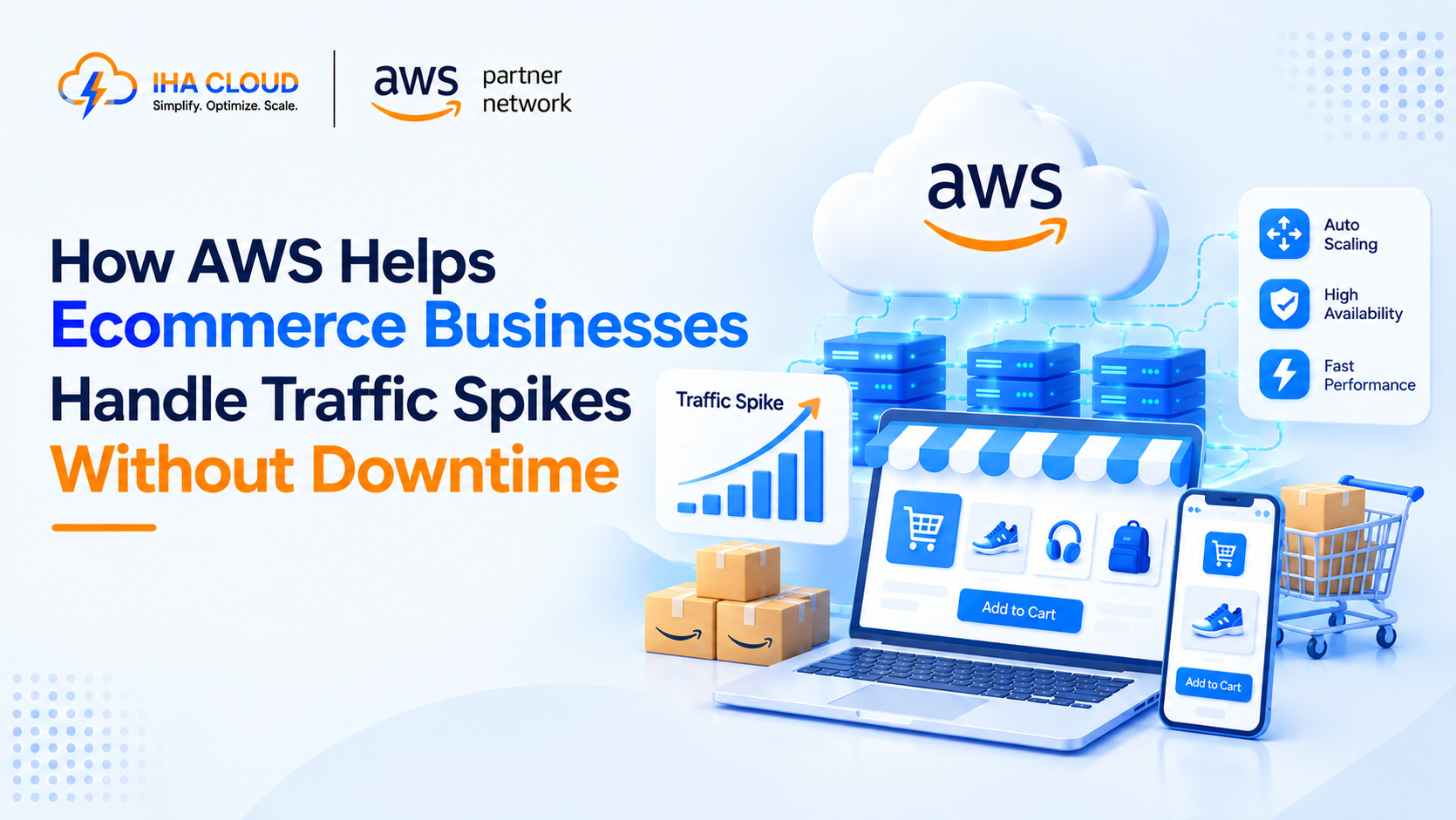
Amazon Web Services (AWS) gives ecommerce businesses the infrastructure and services needed to handle sudden traffic increases, distribute workloads, scale resources, and build highly available applications.
But simply hosting an ecommerce website on AWS isn’t enough. The architecture needs to be designed for the way ecommerce traffic actually behaves.
That’s where the right cloud strategy makes the difference.
Why Traffic Spikes Are a Serious Ecommerce Problem
Ecommerce traffic is rarely predictable.
A website may receive relatively stable traffic for weeks and suddenly experience a major spike because of:
- Black Friday or Cyber Monday
- Diwali and festive sales
- Flash sales
- Product launches
- Influencer campaigns
- Viral social media content
- Successful Google or Meta advertising campaigns
- Limited-time offers
The challenge isn’t only handling more visitors.
A traffic spike can increase demand across the entire technology stack—including web servers, APIs, databases, search, payment workflows, and third-party integrations.
If one component becomes a bottleneck, the customer experience can suffer.
And customers don’t usually wait for a slow website to recover.
According to Google’s research, 53% of mobile site visits are abandoned when pages take longer than three seconds to load.
For ecommerce businesses, performance isn’t just a technical metric. It’s part of the revenue experience.
How AWS Helps Ecommerce Businesses Scale
AWS provides multiple services that can work together to create an infrastructure capable of responding to changing demand.
The most important principle is elasticity.
Instead of maintaining enough infrastructure for your biggest possible traffic day, you can design your environment to scale according to demand.
A simplified ecommerce architecture could look like:
Customer → Amazon CloudFront → Load Balancer → Application Servers → Database
Additional services can support caching, storage, monitoring, security, and asynchronous processing.
Let’s look at how each layer helps.
1. Auto Scaling Adds Capacity When Demand Increases
One of the biggest advantages of AWS for ecommerce is the ability to automatically scale computing resources.
With Amazon EC2 Auto Scaling, businesses can configure infrastructure to add or remove instances based on predefined conditions.
For example:
Normal traffic:
5 application servers
Traffic increases:
10 servers
Major sale:
20+ servers
Traffic returns to normal:
Infrastructure scales back down
This means you’re not paying for peak capacity all year just because you need it for a few major events.
Ecommerce use case
Suppose an online fashion retailer normally receives 2,000 concurrent visitors but expects 20,000 during a major sale.
Instead of manually adding servers before the event, the company can design its AWS environment to automatically respond to increased demand.
That’s the difference between scaling infrastructure manually and building for elasticity from the beginning.
2. Load Balancing Prevents One Server From Becoming a Bottleneck
Adding more servers isn’t enough if traffic isn’t distributed properly.
AWS Elastic Load Balancing can distribute incoming requests across multiple application resources.
Instead of:
10,000 requests → One server
the architecture can distribute traffic across multiple healthy servers.
This improves resilience and reduces the risk of a single server becoming overloaded.
If one application server fails, traffic can also be redirected to healthy resources, depending on the architecture and health-check configuration.
For ecommerce businesses, this supports a more reliable shopping experience during high-demand periods.
3. Amazon CloudFront Helps Deliver Content Faster
Ecommerce websites often serve large amounts of static content:
- Product images
- CSS
- JavaScript
- Videos
- Website assets
Amazon CloudFront is AWS’s content delivery network (CDN), designed to deliver content closer to users through a global network of edge locations.
For an ecommerce company serving customers across different geographic regions, this can help reduce latency and improve page-loading performance.
For example, an Indian ecommerce business expanding into Southeast Asia doesn’t necessarily need to serve every static asset directly from its primary infrastructure location.
A CDN can help bring content closer to customers.
Faster content delivery can mean a better shopping experience.
4. Caching Reduces Pressure on Your Database
Not every request needs to reach your database.
Product catalogs, configuration data, session information, and frequently requested content can often be cached depending on the application architecture.
AWS services such as Amazon ElastiCache can help applications retrieve frequently accessed data faster while reducing repeated database queries.
Consider a product page receiving 100,000 requests during a sale.
Without appropriate caching, the application may repeatedly query backend systems for information that doesn’t change frequently.
With an appropriate caching strategy, some of that workload can be served from memory instead.
This can help your application handle higher demand without simply adding more database capacity.
5. Database Scalability Matters Just as Much as Servers
One common mistake is focusing entirely on application servers while ignoring the database.
During a traffic spike, the database can become the real bottleneck.
AWS provides database services and scaling options that can support different ecommerce workloads, including Amazon RDS and Amazon Aurora.
The right choice depends on factors such as:
- Transaction volume
- Read/write patterns
- Application architecture
- Availability requirements
- Data size
- Performance requirements
For high-traffic ecommerce platforms, database architecture should be considered before the traffic spike happens—not after customers start experiencing errors.
6. High Availability Helps Reduce Downtime
Scalability and availability aren’t exactly the same thing.
You can have scalable infrastructure that still has a single point of failure.
AWS allows businesses to design workloads across multiple Availability Zones.
A simplified approach might look like:
Availability Zone A → Application
Availability Zone B → Application
If infrastructure in one Availability Zone experiences an issue, properly designed architectures can continue serving workloads through other resources.
For ecommerce businesses, this is particularly important during major sales when downtime has a direct financial impact.
A Practical Framework for Ecommerce Traffic Spikes
Before launching your next major campaign, use this simple SCALE framework:
S — Study your traffic
Understand normal traffic, peak traffic, concurrent users, and historical campaign performance.
C — Cache what you can
Use CDN and application caching to reduce unnecessary backend requests.
A — Automate scaling
Configure infrastructure to respond automatically to changes in demand.
L — Load balance
Distribute traffic across healthy application resources.
E — Evaluate continuously
Monitor performance, infrastructure health, errors, and costs before, during, and after campaigns.
This turns traffic management from a reactive activity into a repeatable process.
Real-World Ecommerce Use Cases
AWS scalability can be particularly valuable for:
Flash Sales
A limited-time product offer can generate an extreme traffic spike within minutes.
Elastic infrastructure helps businesses prepare for sudden demand.
Seasonal Ecommerce
Diwali, Christmas, Black Friday, and other major shopping periods can create predictable but significantly higher traffic.
Businesses can prepare their infrastructure before the event and scale down afterward.
Product Launches
A new product promoted through influencers or paid campaigns can generate unpredictable demand.
AWS provides the flexibility to respond without permanently maintaining peak infrastructure.
Growing Ecommerce Brands
A business that starts with moderate traffic may eventually serve millions of customers.
AWS allows infrastructure to evolve as the business grows instead of forcing a complete infrastructure rebuild every time traffic increases.
Scalability Doesn’t Mean “Add More Servers”
This is an important distinction.
A poorly designed ecommerce application can still struggle on AWS.
Simply increasing server capacity doesn’t solve problems caused by:
- Inefficient database queries
- Poor application architecture
- Missing caching
- Unoptimized images
- Third-party API bottlenecks
- Incorrect load-balancer configuration
- Poorly designed deployment processes
Cloud scalability is an architecture problem, not just a server problem.
That’s why businesses should evaluate the entire application stack before expecting AWS to solve performance issues automatically.
How IHA Cloud Helps Ecommerce Businesses Scale on AWS
At IHA Cloud, we help businesses design, migrate, manage, and optimize AWS environments around their actual business requirements.
For ecommerce companies, this can include:
AWS Architecture & Migration
Design scalable cloud infrastructure and migrate ecommerce workloads with minimal disruption.
Performance Optimization
Identify application, infrastructure, database, and caching bottlenecks affecting website performance.
Auto Scaling & High Availability
Build infrastructure that can respond to changing demand while reducing single points of failure.
AWS Cost Optimization
Right-size resources and identify unnecessary cloud spending without compromising performance.
Security & Monitoring
Implement appropriate security controls, monitoring, logging, and operational practices.
Managed AWS Support
Provide ongoing cloud management so your team can focus on the ecommerce business instead of infrastructure issues.
Final Takeaway
Traffic spikes are a good problem to have—until your infrastructure can’t handle them.
For ecommerce businesses, the goal isn’t simply to survive a traffic spike. It’s to keep the shopping experience fast, reliable, and available while demand is at its highest.
AWS provides the building blocks to achieve that through auto scaling, load balancing, caching, CDN, database services, monitoring, and high-availability architecture.
But technology alone doesn’t guarantee scalability.
The architecture, configuration, monitoring, and optimization strategy behind it matter just as much.
With the right AWS strategy, an ecommerce business can turn traffic spikes from a potential outage into an opportunity for growth.
IHA Cloud helps ecommerce businesses build AWS infrastructure that’s ready for today’s traffic—and tomorrow’s growth.