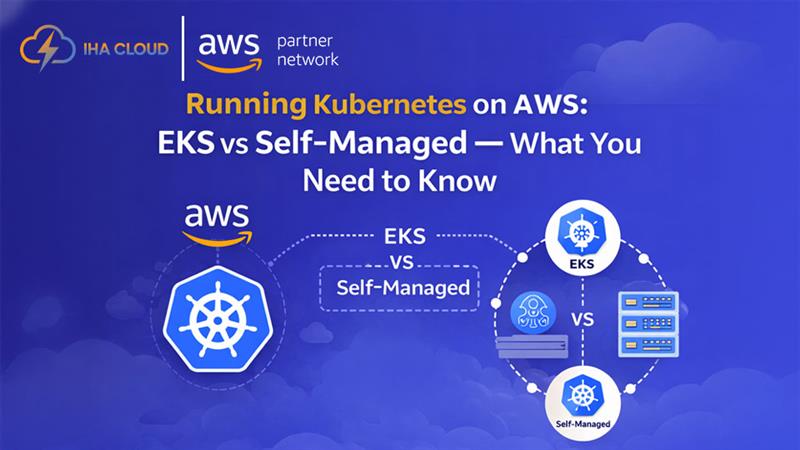
Containers have transformed how modern applications are built and deployed. But running containers at scale requires an orchestration layer — and Kubernetes has become the industry standard. If you’re running containers on AWS, you have two main options: Amazon Elastic Kubernetes Service (EKS) or a self-managed Kubernetes cluster on EC2.
Choosing the wrong approach can cost your team months of effort and thousands of dollars. Here’s what you need to know.
What is Amazon EKS?
Amazon EKS is AWS’s fully managed Kubernetes service. AWS handles the control plane — the master nodes, API server, etcd, and cluster upgrades — so your team only manages worker nodes and workloads.
Key benefits of EKS:
- No control plane management overhead
- Deep integration with AWS services (IAM, ALB, VPC, CloudWatch)
- Automatic Kubernetes version upgrades
- Managed node groups and Fargate support for serverless containers
- SOC 2, ISO 27001, and PCI DSS compliant out of the box
Self-Managed Kubernetes on EC2
Some teams choose to run Kubernetes themselves using tools like kubeadm or kops on EC2 instances.
When this might make sense:
- You need highly specific Kubernetes configurations not supported by EKS
- You want full control over every component including the control plane
- Cost optimisation at very large scale (though this rarely outweighs operational cost)
Challenges:
- Your team owns all upgrades, patches, and control plane failures
- High operational burden on engineering teams
- Harder to integrate with AWS-native services
EKS Cost Considerations
EKS charges $0.10 per cluster per hour (approximately $72/month per cluster) plus EC2 or Fargate costs for worker nodes. For most production workloads, this is excellent value given the management overhead it removes.
Cost optimisation tips for EKS:
- Use Spot Instances for non-critical node groups
- Enable Karpenter for intelligent autoscaling
- Use Fargate only for bursty, unpredictable workloads
- Right-size pods using Vertical Pod Autoscaler (VPA)
IHA Cloud’s EKS Implementation Approach
IHA Cloud designs and manages EKS clusters for production workloads including:
- Cluster architecture design with multi-AZ node groups
- IAM Roles for Service Accounts (IRSA) for secure pod permissions
- ALB Ingress Controller setup for traffic routing
- Helm chart deployment and GitOps pipeline integration
- CloudWatch Container Insights for observability
- Cluster autoscaling with Karpenter
Who Should Move to Kubernetes?
Kubernetes is the right choice when you have multiple microservices, need consistent deployment pipelines, or require fine-grained resource allocation across teams. For simpler applications, AWS ECS or Elastic Beanstalk may be a better fit.