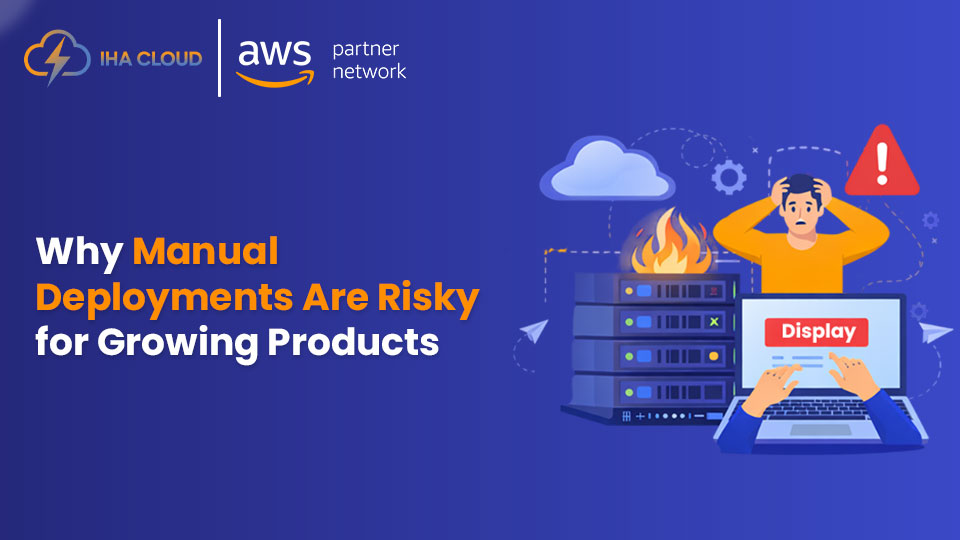
Why Manual Deployments Are Risky for Growing Products
In the early stages of a product, manual deployments often feel simple and manageable. A developer logs into the server, pulls the latest code, runs a few commands, and the update goes live. For a small team, this may work for a while. However, as a product grows, manual deployments start creating risks that directly affect stability, customer trust, and business growth. What Manual Deployment Really Looks Like Manual deployment usually means someone accesses production servers directly and performs steps by hand. These steps may not be documented clearly and often depend on the experience of a specific individual. When deployments rely on people instead of systems, inconsistency becomes unavoidable. Human Error Becomes a Business Risk Even skilled engineers make mistakes. A wrong command, a missed configuration, or a deployment to the wrong environment can take an application down. As the number of deployments increases, the chances of failure increase as well. What was once a minor inconvenience can quickly turn into customer facing downtime. Environment Differences Create Hidden Problems With manual deployments, development, testing, and production environments often differ in small but important ways. These differences cause issues that only appear after a release goes live. This leads to delays, emergency fixes, and wasted engineering time trying to reproduce problems that should never have reached production. Downtime Affects Revenue and Brand Trust For growing products, availability is no longer optional. Users expect applications to be accessible at all times. Manual deployments often require service restarts or maintenance windows. Even short outages can lead to lost users and reduced confidence in the product. Scaling Makes Manual Processes Unmanageable As infrastructure grows, deployments become more complex. Multiple servers, load balancers, and services need to be updated together. Manual deployment does not scale with the product. What works on a single server becomes slow, error prone, and risky across multiple environments. Rollbacks Are Slow and Uncertain When a release fails, teams need to act quickly. Manual deployment rarely provides a clear and reliable rollback process. Without proper version control and automation, rolling back a release can be just as risky as deploying it in the first place. Security Risks Increase Over Time Manual deployments often require direct server access. Credentials are shared, audit logs are missing, and there is little visibility into who deployed what and when. For businesses handling customer data, this creates serious security and compliance concerns. Why Automated Deployments Are Essential Automated CI/CD pipelines replace uncertainty with consistency. Code is tested, built, and deployed in a repeatable way. Releases become predictable and easier to control. Automation reduces risk, shortens release cycles, and allows teams to focus on improving the product instead of fixing deployment issues. How IHA Cloud Supports Reliable Deployments At IHA Cloud, we help growing companies move away from fragile manual deployments and build reliable, automated delivery pipelines. We design and implement CI/CD pipelines tailored to your product and infrastructure. We ensure deployments are secure, auditable, and scalable, while minimizing downtime and operational overhead. Our goal is to make deployments stable, predictable, and aligned with your business growth. Closing Thoughts Manual deployments may work when a product is small. They become a liability as the product gains users and revenue.
Why Manual Deployments Are Risky for Growing Products Read More »