How do you know if your AWS infrastructure is truly well-built? Many businesses spend years accumulating cloud resources without ever stepping back to assess whether their architecture follows best practices. The result is often a mix of performance bottlenecks, security gaps, hidden costs, and reliability risks.
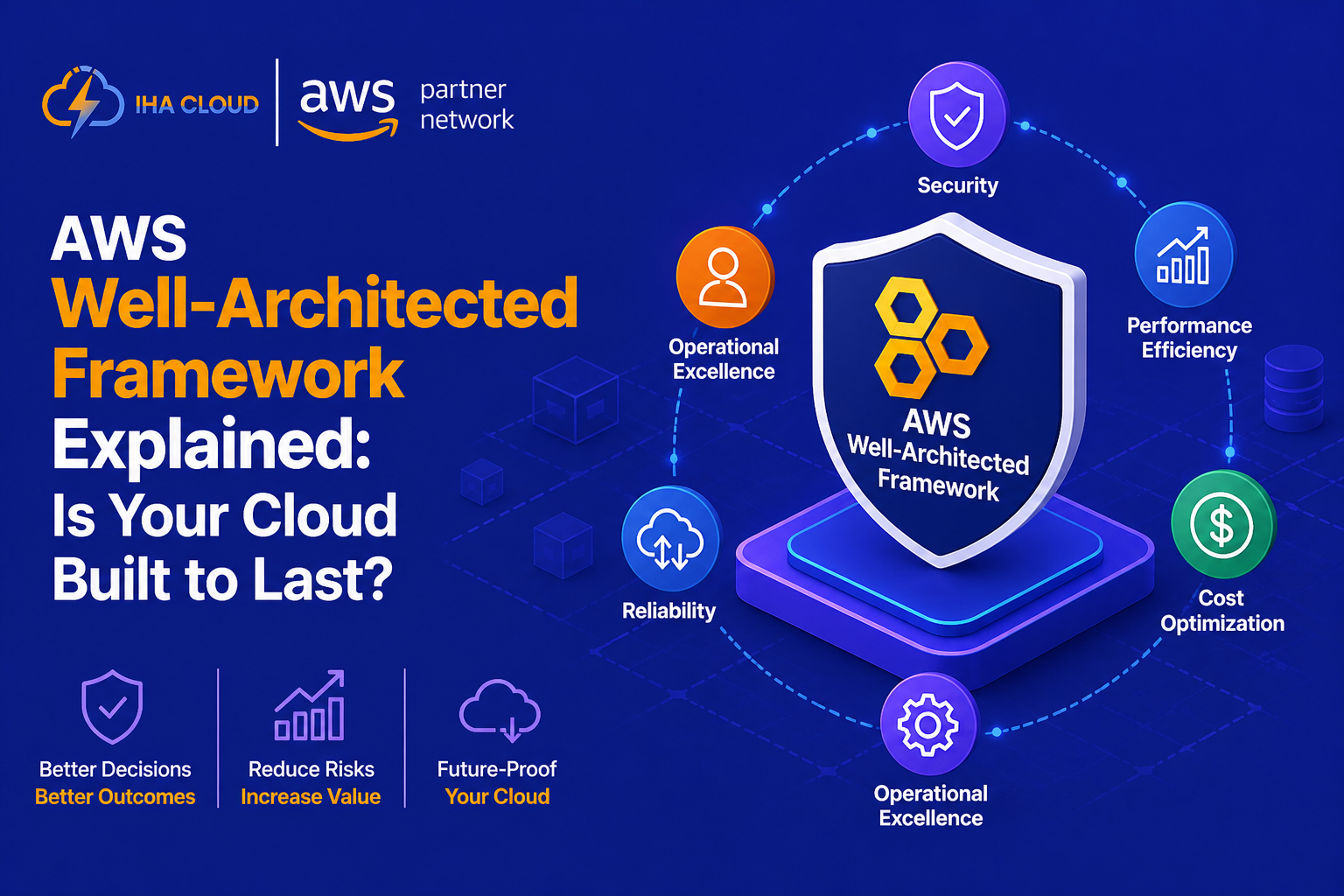
The AWS Well-Architected Framework is AWS’s official methodology for evaluating and improving cloud architectures. At IHA Cloud, it’s the lens through which we assess every new client’s infrastructure.
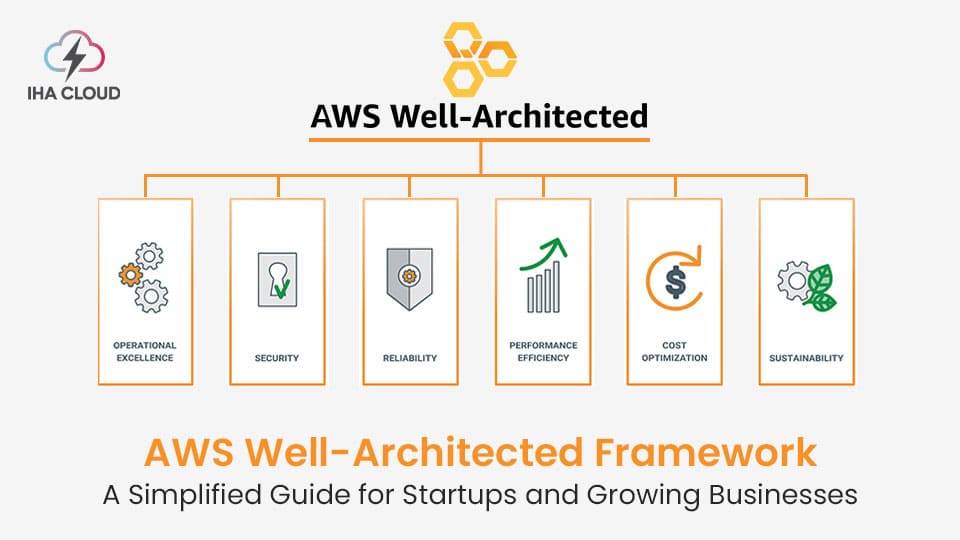
The Six Pillars of the AWS Well-Architected Framework
Operational Excellence
Can your team run and monitor systems effectively and continuously improve processes?
Key practices:
- Define runbooks and playbooks for common operations tasks
- Implement CI/CD pipelines for infrastructure and application changes
- Use CloudWatch dashboards and alarms for full observability
- Conduct regular post-incident reviews (blameless post-mortems)
Security
Are your workloads protected from threats at every layer?
Key practices:
- Apply IAM least privilege across all accounts and services
- Enable GuardDuty, Security Hub, and CloudTrail in every account
- Encrypt data at rest and in transit without exception
- Automate security response using EventBridge and Lambda
Reliability
Can your workload recover from failures and meet availability requirements?
Key practices:
- Design for failure — assume every component will fail eventually
- Use Multi-AZ deployments for databases and compute
- Implement automated backups and test recovery procedures
- Use Circuit Breaker patterns for inter-service dependencies
Performance Efficiency
Are you using the right AWS resources for each workload, at the right size?
Key practices:
- Regularly review instance types against Compute Optimizer recommendations
- Use purpose-built databases (DynamoDB, ElastiCache, OpenSearch) instead of overloading a single RDS instance
- Benchmark performance regularly and establish baselines
- Evaluate newer instance generations (e.g., Graviton3) for better price-performance
Cost Optimisation
Are you paying only for what you need, and getting maximum value from your spend?
Key practices:
- Tag every resource and implement showback/chargeback
- Purchase Savings Plans for predictable workloads
- Eliminate idle resources with automated cleanup policies
- Use S3 Intelligent-Tiering and lifecycle policies for storage
Sustainability
Are you minimising the environmental impact of your cloud workloads?
Key practices:
- Rightsize instances to avoid waste
- Use managed services that allow AWS to optimise underlying hardware utilisation
- Choose AWS regions powered by higher percentages of renewable energy where feasible
- Implement auto-scaling to reduce idle compute capacity
What is a Well-Architected Review?
A Well-Architected Review (WAR) is a structured assessment of your AWS workloads against these six pillars. AWS provides a free tool — the AWS Well-Architected Tool — that guides the review process and generates a prioritised list of improvement recommendations.
IHA Cloud conducts formal Well-Architected Reviews as part of our onboarding process for new clients, and as a periodic health check for existing clients.
What You Get from an IHA Cloud Well-Architected Review
- A full assessment of your workloads across all six pillars
- A prioritised improvement plan with effort and impact ratings
- Hands-on remediation of high-risk findings
- A baseline report for future comparison
- AWS Well-Architected Partner Review eligibility — which may qualify you for AWS credits