Generative AI is changing how businesses develop applications, manage information, and interact with customers. From answering customer questions to summarizing documents and automating repetitive tasks, AI is creating new opportunities for businesses of all sizes.
However, adopting generative AI does not mean a business needs to train its own AI model, build complex infrastructure, or hire a large team of AI specialists.
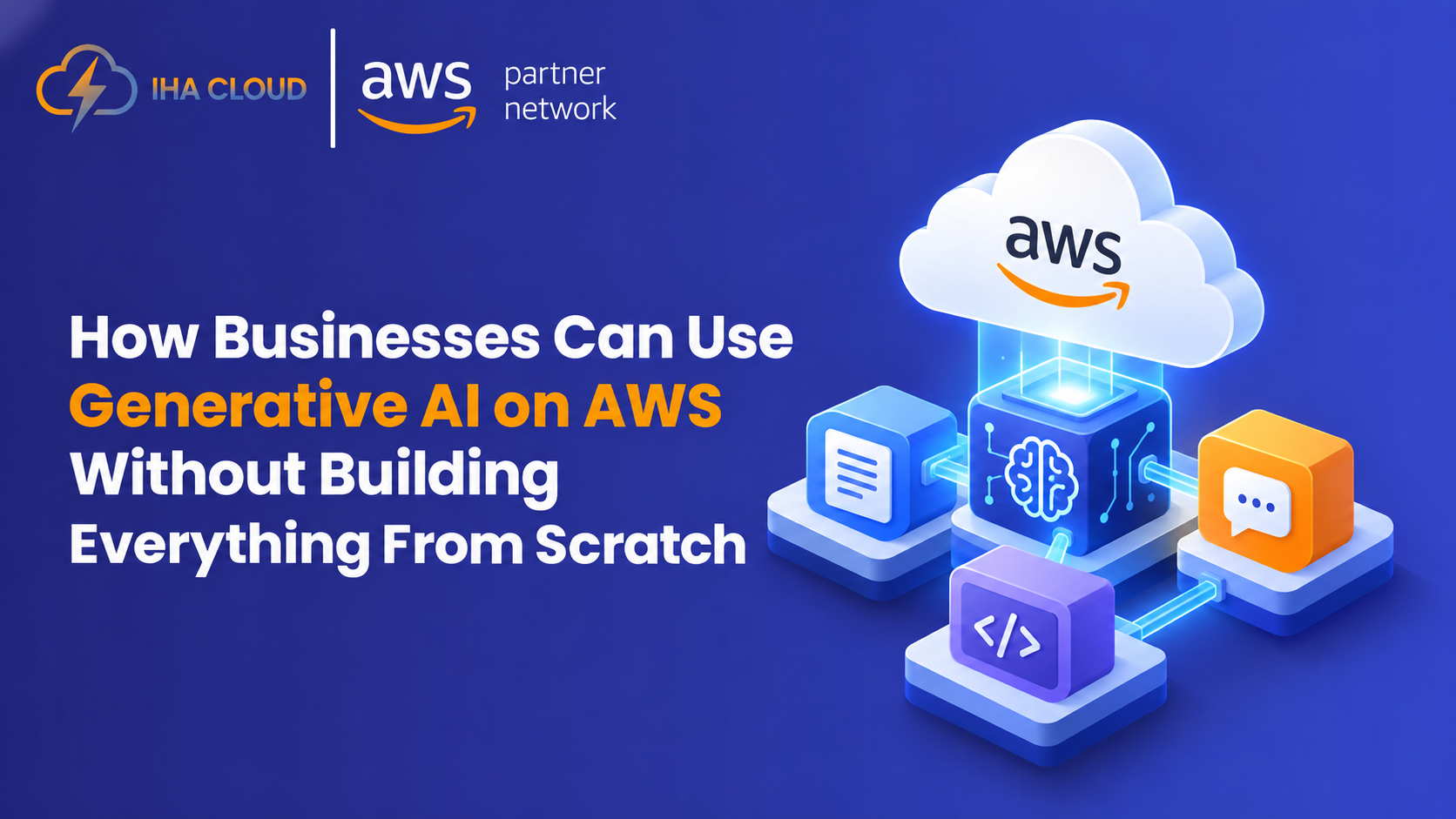
With Amazon Web Services (AWS), businesses can use managed AI services and existing foundation models to build practical AI-powered solutions without starting from zero.
The key is understanding which services to use, how to connect them with existing applications, and how to keep the solution secure, scalable, and cost-effective.
Why Businesses Don’t Need to Build AI From Scratch
Developing an AI model from the ground up requires data, computing resources, technical expertise, testing, and ongoing maintenance. For many businesses, this can create unnecessary complexity before they have even identified a clear use case.
Instead, businesses can use existing foundation models and managed cloud services to develop applications around their specific needs.
For example, a company that wants to create an AI customer support assistant does not necessarily need to train its own language model. It can use an existing model, connect it to approved company information, and build an application that responds to customer questions.
This approach allows businesses to focus on solving business problems rather than managing every component of the AI technology stack.
1. Use Amazon Bedrock to Build Generative AI Applications
One of the main AWS services for this approach is Amazon Bedrock.
Amazon Bedrock provides access to foundation models through a managed service. Businesses can use supported models for tasks such as text generation, summarization, question answering, and other generative AI applications.
Instead of building a model from scratch, developers can integrate a suitable model into an application through APIs.
Businesses can use Amazon Bedrock to develop solutions such as:
- AI-powered customer support assistants
- Document summarization tools
- Internal knowledge assistants
- Content generation workflows
- Business research and information retrieval tools
- AI-powered application features
The appropriate model depends on the use case, performance requirements, quality expectations, and cost.
For many organizations, starting with a managed foundation model is a more practical first step than investing in custom model development.
2. Build an AI Assistant Using Existing Business Documents
Businesses often have valuable information stored in PDFs, internal documentation, product guides, policies, and knowledge bases. Finding the right information across these sources can take time.
Generative AI can make this information easier to access.
For example, a company could build an internal assistant that helps employees find answers to questions about company policies, product documentation, or technical procedures.
A common approach is Retrieval-Augmented Generation (RAG).
With RAG, the application retrieves relevant information from a trusted data source and provides that context to the AI model before generating a response.
A solution might use Amazon Bedrock for model access, Amazon S3 to store documents, and a supported retrieval or knowledge-base solution to find relevant information.
This approach can help businesses create AI assistants that respond using their own content rather than relying only on the model’s general knowledge.
However, the quality of the responses still depends on the quality of the source documents, retrieval process, permissions, and application design.
3. Automate Repetitive Business Tasks
Many business processes involve repetitive activities such as classifying requests, summarizing information, extracting key details, and preparing initial responses.
Generative AI can help automate parts of these workflows.
Consider a business that receives hundreds of customer emails every day. Employees may need to identify the issue, categorize the request, summarize the customer’s concern, and forward it to the appropriate team.
An AI-powered workflow could help classify incoming messages, generate summaries, and recommend the next action.
AWS services can support different parts of this process. Amazon Bedrock can provide generative AI capabilities, while AWS Lambda can execute application logic and connect different services.
For document-heavy processes, Amazon Textract can extract text and structured information from supported document types. Generative AI can then help summarize or interpret the extracted content.
Businesses should keep human review for decisions that are sensitive, high-impact, or likely to require judgment.
4. Add AI Features to Existing Applications
Businesses do not always need to develop a separate AI product. In many cases, they can add AI capabilities to applications they already use.
For example, an e-commerce platform could introduce a product information assistant. A SaaS company could add an AI search feature to its dashboard. A customer support platform could generate conversation summaries for agents.
AWS provides infrastructure and services that help developers integrate AI into existing application architectures.
A typical implementation may include:
- An existing web or mobile application
- An API layer to receive requests
- Amazon Bedrock for model access
- A backend service to process information
- A database or knowledge source
- Authentication, logging, and monitoring
This architecture allows a business to introduce AI features incrementally without rebuilding its entire technology stack.
The implementation should also consider response times, usage limits, data handling, and what happens when the AI service is unavailable.
5. Protect Business Data When Using Generative AI
Security is an important consideration when introducing AI into business operations.
Applications may process customer details, internal documents, financial information, or confidential business data. Organizations need to decide which information the AI application can access and how that information should be handled.
AWS provides services and controls that can help businesses build more secure cloud architectures.
Important considerations include:
- Identity and access management: Restrict access to authorized users and services.
- Data protection: Apply suitable encryption and data-handling controls.
- Network security: Configure network access according to the application’s requirements.
- Monitoring: Record and review relevant application activity.
- Permission-aware retrieval: Ensure users can retrieve only the documents they are authorized to access.
- AI safeguards: Test model responses, validate outputs, and apply appropriate content and security controls.
Security should be part of the initial design rather than something added after the AI application is deployed.
Businesses should also review the data-handling terms and configuration of the specific services they choose.
6. Manage Generative AI Costs on AWS
Although managed AI services can reduce the need to operate complex infrastructure, AI applications still require cost planning.
Costs can depend on factors such as model selection, input and output token usage, request volume, supporting infrastructure, data storage, and retrieval operations. Pricing also varies by service and configuration.
Businesses can take several practical steps to manage these expenses.
Choose the right model. A smaller or less expensive model may be sufficient for routine classification and summarization tasks, while more complex tasks may require a more capable model.
Limit unnecessary context. Sending large amounts of irrelevant information with every request can increase usage costs and affect response quality.
Monitor usage. Track request volume, model consumption, and supporting AWS resource costs.
Test before scaling. Run a proof of concept with realistic workloads to understand performance and expected costs.
Review the architecture. Avoid unnecessary services, oversized infrastructure, and inefficient processing workflows.
Cost optimization should not come at the expense of accuracy, security, or reliability. The objective is to find a balance that supports the business use case.
7. Start With a Small Proof of Concept
One of the most effective ways to adopt generative AI is to begin with a limited project.
Rather than introducing AI across the entire organization, choose one process where the expected benefit is clear.
For example, a business could start with an internal document assistant, an automated support-ticket summarizer, or a tool that helps employees search technical documentation.
A practical proof of concept should define:
- The business problem to solve.
- The information the application needs to access.
- The AWS services required.
- The security and access controls.
- The expected usage and operating cost.
- The metrics that will determine success.
Once the solution has been tested, the business can evaluate its accuracy, usefulness, cost, and performance before deciding whether to expand it.
This reduces the risk of investing heavily in a solution before understanding its real-world value.
How IHA Cloud Helps Businesses Adopt AI on AWS
Adopting generative AI involves more than selecting a model. Businesses also need suitable cloud infrastructure, secure application architecture, deployment processes, performance monitoring, and cost management.
IHA Cloud helps businesses build, manage, and optimize their AWS environments to support modern applications and evolving technology requirements.
Our team can help businesses with:
- AWS infrastructure setup and management
- Cloud architecture and application deployment
- Application and database migration to AWS
- DevOps and CI/CD implementation
- Cloud security and access configuration
- Performance monitoring and scalability planning
- AWS cost optimization
For businesses exploring generative AI, a well-designed cloud environment can provide a foundation for integrating AI services into existing applications and workflows.
The right starting point is not necessarily a large AI transformation. It may be a single application feature, an internal knowledge assistant, or a repetitive process that can be improved through automation.
By starting with a defined business problem, selecting appropriate AWS services, and measuring the results, businesses can explore generative AI without building everything from scratch.
Looking to prepare your AWS environment for modern applications and AI adoption? Connect with IHA Cloud to explore a practical approach to your cloud requirements.