Moving to AWS can give businesses more flexibility, scalability, and control over their infrastructure. But once your workloads are running in the cloud, another question comes up:
Who should manage it?
Should your internal IT or DevOps team handle everything? Or should you work with an AWS managed services provider?
There isn’t one answer for every business. The right choice depends on your team, workload complexity, budget, security requirements, and how much time you want to spend managing infrastructure.
Let’s break down both approaches.
What Is In-House AWS Management?
With in-house cloud management, your own employees are responsible for your AWS environment.
This can include:
- AWS infrastructure management
- Security and access control
- Monitoring and alerts
- Backup and disaster recovery
- Performance optimization
- Cost management
- Deployments and CI/CD
- Troubleshooting
- Infrastructure scaling
For businesses with an experienced DevOps or cloud engineering team, this approach can provide a high level of control.
Your team already understands the applications, internal processes, and business requirements, which can make day-to-day decisions easier.
However, managing AWS internally also requires ongoing investment in people, skills, tools, and processes.
What Are AWS Managed Services?
With AWS managed services, an external cloud partner manages some or all aspects of your AWS environment.
The exact scope depends on the provider and your requirements.
A managed service provider may help with:
- AWS infrastructure management
- 24/7 monitoring
- Security management
- Cloud migration
- Backup and disaster recovery
- Cost optimization
- Performance monitoring
- DevOps and CI/CD
- Incident response
- AWS architecture
This can allow your internal team to focus more on applications and business priorities while cloud specialists handle infrastructure operations.
AWS Managed Services vs. In-House Management
The biggest difference isn’t simply internal vs. external.
It’s about where your business wants to invest its time and expertise.
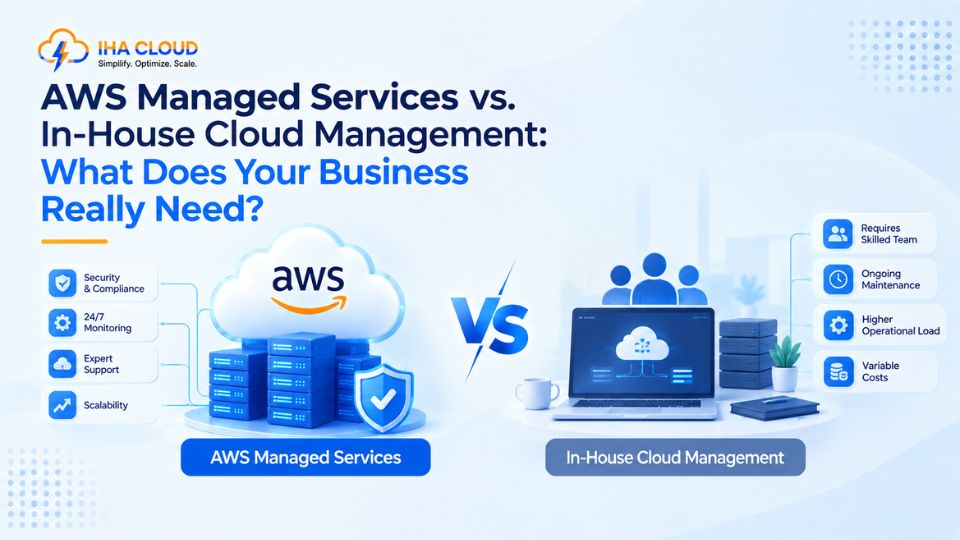
| Area | In-House Management | AWS Managed Services |
|---|---|---|
| Cloud expertise | Built internally | Provided by cloud experts |
| Infrastructure control | High | Shared, based on agreement |
| Hiring requirements | Higher | Lower |
| 24/7 monitoring | Requires internal coverage | Often included |
| AWS cost optimization | Internal responsibility | Can be handled by provider |
| Security management | Internal responsibility | Shared with provider |
| Scalability | Depends on internal resources | Provider can support growth |
| Operational workload | Higher | Lower |
Neither model is automatically right for every organization.
When Does In-House Management Make Sense?
Managing AWS internally can make sense when you already have a strong cloud engineering team.
For example, a SaaS company with experienced DevOps engineers may prefer to maintain direct control over its AWS infrastructure.
An in-house approach may be suitable when:
You already have AWS expertise
If your team has strong experience with AWS architecture, DevOps, security, and cloud operations, bringing in an external provider may not be necessary for every workload.
Cloud infrastructure is a core competency
For technology companies where infrastructure is closely connected to the product, keeping cloud operations internally can make strategic sense.
You need extensive customization
Some organizations have highly specialized environments that require close involvement from internal engineers.
However, businesses should also consider the operational cost of maintaining that expertise.
Cloud engineers need continuous training, and infrastructure requires attention even when everything is working normally.
When Should You Consider AWS Managed Services?
Managed services can be particularly useful for businesses that don’t want to build a large internal cloud operations team.
Your IT team is already stretched
If your internal team is spending too much time troubleshooting infrastructure instead of working on strategic projects, managed services can reduce that operational burden.
You Need Continuous Monitoring
Cloud infrastructure doesn’t follow a 9-to-5 schedule.
Applications can experience issues at any time.
A managed AWS provider can provide monitoring and operational support based on the service level your business requires.
You’re Growing Quickly
As workloads grow, your infrastructure becomes more complex.
You may need additional expertise in:
- Architecture
- Security
- Databases
- Networking
- Automation
- Cost optimization
An experienced AWS partner can provide access to those skills without requiring you to build every capability internally.
Don’t Forget AWS Cost Management
One of the biggest misconceptions about cloud is that moving to AWS automatically makes infrastructure cheaper.
It doesn’t.
Poorly optimized cloud environments can accumulate unnecessary costs through unused resources, oversized instances, inefficient storage, and other configuration issues.
Whether you manage AWS internally or use managed services, cloud cost optimization should be an ongoing process.
A good management approach should regularly review:
- Resource utilization
- Compute costs
- Storage
- Database usage
- Reserved capacity and pricing options
- Unused resources
- Environment schedules
The goal isn’t simply to spend less.
It’s to make sure your infrastructure is delivering the right level of performance and reliability for the money you’re spending.
A Hybrid Approach Can Also Work
Businesses don’t always have to choose one model.
A hybrid approach can combine internal expertise with external AWS support.
For example:
Internal team: Application development, product decisions, architecture ownership
AWS partner: Infrastructure monitoring, cost optimization, security reviews, backups, and operational support
This model can be useful for businesses that want to maintain control over their technology while reducing the day-to-day infrastructure workload.
A Simple Framework for Choosing
Before deciding between in-house and managed AWS services, ask these five questions:
1. Do we have enough AWS expertise internally?
If not, managed services can fill the skills gap.
2. Can our team provide the required operational coverage?
If your business needs continuous monitoring and support, consider how you’ll cover it internally.
3. How complex is our AWS environment?
A few workloads are very different from managing a large, multi-service cloud environment.
4. Are cloud costs being actively optimized?
If nobody owns cost management, spending can become difficult to control.
5. Where should our team spend its time?
If engineers are spending most of their time maintaining infrastructure instead of improving the product, outsourcing some cloud operations may be worth considering.
How IHA Cloud Supports AWS Management
At IHA Cloud, we help businesses manage AWS environments without forcing them into a one-size-fits-all model.
Our services can include:
- AWS infrastructure management
- Cloud migration
- DevOps and CI/CD
- AWS cost optimization
- Security audits
- Performance optimization
- Monitoring and support
- Cloud architecture
Depending on your existing team and requirements, IHA Cloud can support specific parts of your AWS environment or provide broader managed cloud services.
The objective is simple: help businesses get more from AWS while reducing unnecessary operational complexity.
Final Thoughts
The question isn’t whether managed AWS services are better than in-house cloud management.
The better question is:
What does your business actually need?
If you have a mature cloud team and infrastructure is a core internal capability, managing AWS yourself may make sense.
If your team is small, workloads are growing, or cloud operations are taking too much time, managed AWS services can provide additional expertise and operational support.
And for many businesses, the answer may be somewhere in between.
The right model is the one that gives your team the expertise, control, reliability, and cost visibility needed to support your business as it grows.